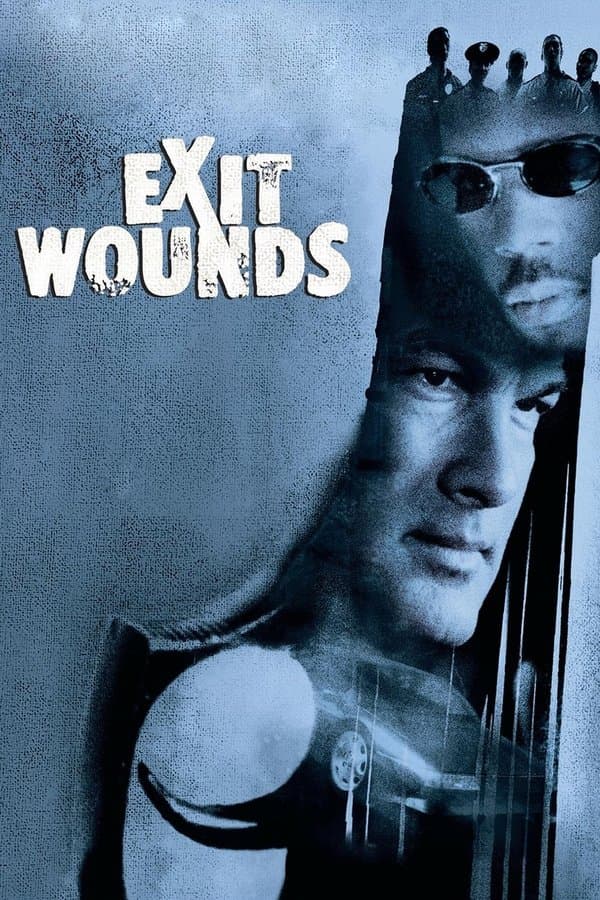
Exit Wounds
2001 • Action, Crime, Thriller • R
Maverick cop Orin Boyd always brings down the domestic terrorists he tracks, but he ruffles feathers with his unorthodox techniques -- and soon finds himself reassigned to the toughest district in Detroit. When he discovers a group of detectives secretly operating a drug ring, Boyd joins forces with an unlikely ally -- gangster Latrell Walker -- to bring down the rotten cops.
Runtime: 1h 41m
Buy related books from Amazon
As an Amazon Associate I earn from qualifying purchases. Read the full disclosure.
Why you should read the novel
If you loved the adrenaline of the Exit Wounds movie, discover where it all began by reading Exit Wounds by John Westermann. This gripping crime novel delivers layered police work, sharp dialogue, and authentic procedural detail you won’t find on screen. For fans of crime fiction and police procedurals, the book offers a deeper, more immersive experience.
The Exit Wounds novel by John Westermann builds tension through character, investigation, and atmosphere. Instead of nonstop explosions, you’ll get smart plotting, moral complexity, and the texture of real-world policing. It’s the perfect choice for readers who want substance, nuance, and the satisfying logic of a well-crafted case.
Skip the quick thrills and choose the richer story. Reading the Exit Wounds book gives you insight into motives, institutions, and consequences that the movie can only hint at. For a definitive take on the story’s themes of law, loyalty, and corruption, start with the novel.
Adaptation differences
Exit Wounds movie vs book differences begin with setting and tone. John Westermann’s Exit Wounds is rooted in East Coast policing culture and procedural realism, while the film relocates the action to a stylized big-city battlefield, prioritizing spectacle, martial-arts-driven set pieces, and a glossy early-2000s vibe.
Character focus also shifts. The novel emphasizes ensemble dynamics, departmental politics, and the cumulative pressure of the job. The movie reframes the story around a singular action hero and larger-than-life antagonists, compressing or combining roles and streamlining relationships to fit a high-octane action framework.
Plot mechanics diverge significantly. Westermann’s book develops investigations through legwork, informants, and bureaucratic friction; the film escalates into an expansive corrupt-cop conspiracy with high-tech twists and hyperkinetic showdowns. Themes of institutional process and moral ambiguity in the novel become a faster, cleaner battle between hero and corruption in the adaptation.
Structure and pacing complete the contrast. The Exit Wounds novel unfolds as a slow-burn police procedural with incremental reveals and grounded consequences. The movie accelerates the timeline, opts for bigger stakes and explosive climaxes, and resolves conflicts through action-forward catharsis rather than the methodical, detail-driven resolutions that crime-fiction readers expect.
Exit Wounds inspired from
Exit Wounds
by John Westermann