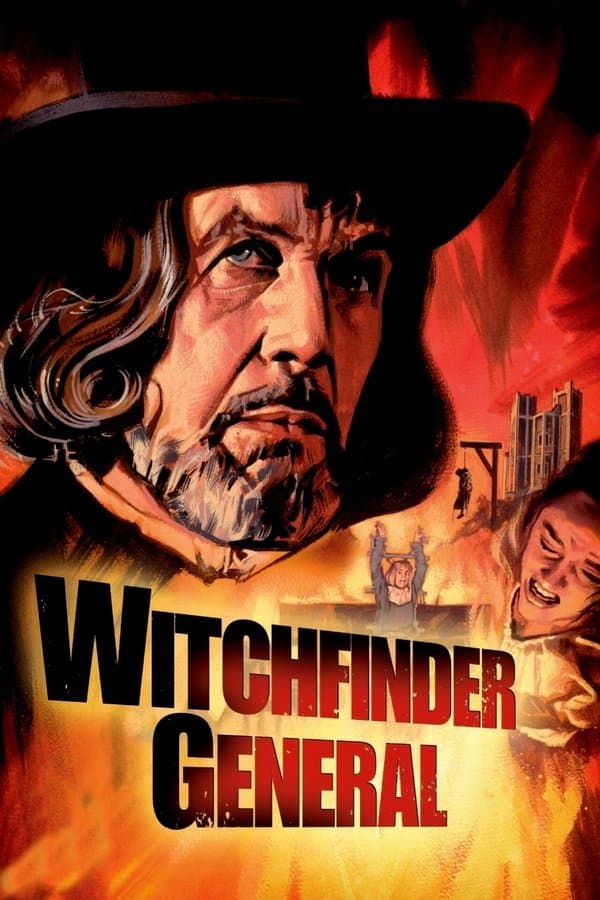
Witchfinder General
1968 • Drama, History, Horror • NR
England, 1645. The cruel civil war between Royalists and Parliamentarians that is ravaging the country causes an era of chaos and legal arbitrariness that allows unscrupulous men to profit by exploiting the absurd superstitions of the peasants; like Matthew Hopkins, a monster disguised as a man who wanders from town to town offering his services as a witch hunter.
Runtime: 1h 27m
Buy related books from Amazon
As an Amazon Associate I earn from qualifying purchases. Read the full disclosure.
Why you should read the novel
If the movie’s grim atmosphere gripped you, the Witchfinder General novel by Ronald Bassett delivers an even richer, more immersive encounter with Matthew Hopkins and the English Civil War. It is historical fiction that reads with the urgency of true crime.
Bassett’s book explores the social panic, religious zeal, and political fractures that fueled witch hunts, giving you context the film can only hint at. You get psychology, motive, and the machinery of persecution rendered with chilling authenticity.
For readers who prefer depth over spectacle, reading the novel offers nuance and moral complexity the screen cannot match. Discover the definitive Witchfinder General book experience and witness how history breeds horror without leaving the page.
Adaptation differences
The Witchfinder General movie streamlines the story into a tight horror-thriller, centering on a personal revenge arc to drive momentum. Ronald Bassett’s novel instead foregrounds Hopkins and his associate John Stearne, expanding the geography, civic institutions, and legal rituals behind the witch hunts.
Characterization differs markedly. On screen, Hopkins is an almost elemental embodiment of cruelty, his motives left stark and opaque. In the novel, he is a calculating climber shaped by war, profit, and piety; Bassett gives him a more textured psychology and grants Stearne additional dimension beyond brute force.
Tone and detail diverge as well. The film emphasizes graphic set pieces and relentless dread, while the book builds a procedural terror from accusations, examinations, and coerced confessions. The novel’s broader historical canvas highlights class tensions, local politics, and Puritan ideology that the adaptation compresses or omits.
The ending and timeline are also treated differently. The film culminates in an abrupt, cathartic finale, whereas the novel unspools Hopkins’s downfall more gradually and with greater historical plausibility. And unlike the movie’s later U.S. Poe-branded marketing, the book is straight historical fiction with no literary framing device.
Witchfinder General inspired from
Witchfinder General
by Ronald Bassett