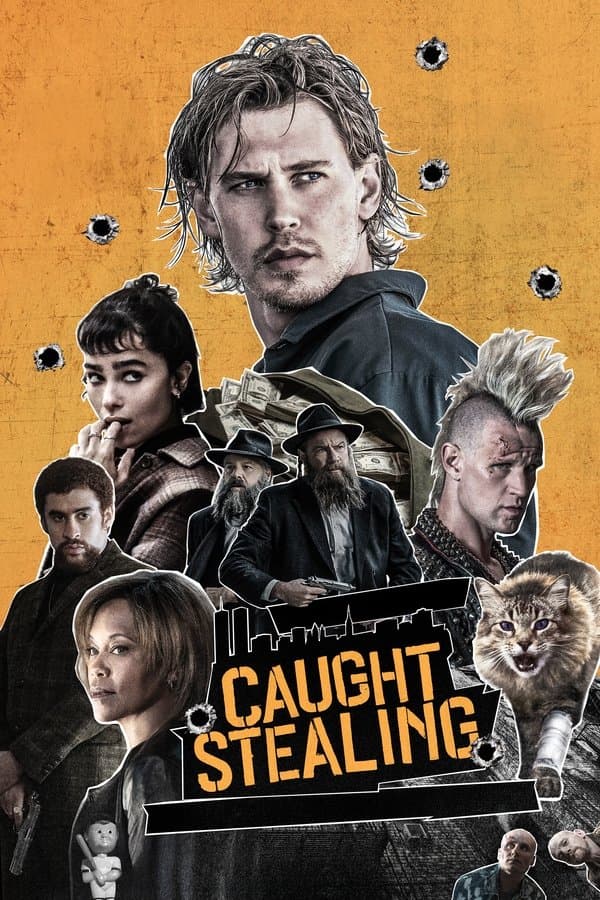
Caught Stealing
2025 • Comedy, Crime, Thriller • R
Burned-out ex-baseball player Hank Thompson unexpectedly finds himself embroiled in a dangerous struggle for survival amidst the criminal underbelly of late 1990s New York City, forced to navigate a treacherous underworld he never imagined.
Runtime: 1h 47m
Buy related books from Amazon
As an Amazon Associate I earn from qualifying purchases. Read the full disclosure.
Why you should read the novel
Before you watch the 2025 movie, experience Charlie Huston’s Caught Stealing as it was meant to be felt: breathless, bruised, and beating from inside Hank Thompson’s head. Huston’s razor-wire sentences and gallows humor turn every corner of New York into a pressure cooker, delivering the kind of immersive dread and momentum movies struggle to match.
Reading the novel gives you the full measure of Hank—his busted dreams, barroom past, and the split-second choices that shove him from ordinary guy to hunted survivor. Huston’s voice is kinetic and intimate, building character through action, injury, and panic with an immediacy that keeps pages flipping like a pulse.
Start with Caught Stealing and you also unlock the hard-charging Hank Thompson trilogy, flowing into Six Bad Things and A Dangerous Man. If you crave relentless crime fiction, visceral city textures, and a darkly comic edge, the book delivers a richer, more personal impact than any two-hour adaptation ever could.
Adaptation differences
Curious about the differences between the Caught Stealing movie and the book? Expect the biggest shift in voice. Huston’s novel traps you in Hank’s first-person, adrenaline-soaked narration—his fear, pain, and cracked humor. A film must externalize that inner monologue, often swapping it for visual shorthand, dialogue tweaks, or selective voiceover, which can change the story’s tone and intimacy.
The movie-versus-book comparison will likely hinge on plot compression. Novels carry bruised detours, secondary characters, and grimy subplots that build pressure. A theatrical runtime tends to streamline: composite characters, merged locations, trimmed backstory (including Hank’s personal history), and rearranged chronology to keep the cat-and-mouse momentum cinematic while sacrificing some of the novel’s layered buildup.
Another common adaptation difference involves violence, setting texture, and time period. Huston’s fights are graphic, painful, and specific to New York’s street-level geography. Films often stylize or calibrate intensity for ratings and pacing. Neighborhoods, era markers, or cultural references may be updated or relocated, altering the book’s gritty place-and-time feel in favor of a sleeker, more universal backdrop.
Endings and sequel setup can also diverge. The novel’s close positions Hank for the next entries in the trilogy; a film might chase cleaner closure, tease follow-ups differently, or reframe character fates to stand alone. If you want the fullest arc—and the raw, unfiltered logic behind Hank’s choices—the book remains the definitive version to compare against the adaptation.
Caught Stealing inspired from
Caught Stealing
by Charlie Huston