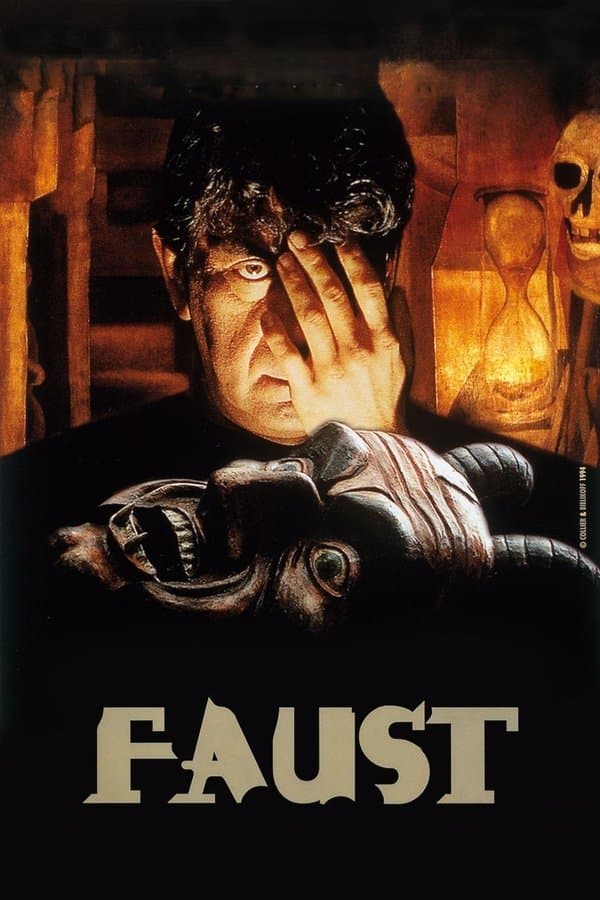
Faust
1994 • Animation, Fantasy
A very free adaptation of Marlowe's "Doctor Faustus", Goethe's "Faust" and various other treatments of the old legend of the man who sold his soul to the devil. A nondescript man is lured by a strange map into a sinister puppet theatre, where he finds himself immersed in an indescribably weird version of the play, blending live actors, clay animation and giant puppets.
Runtime: 1h 37m
Buy related books from Amazon
As an Amazon Associate I earn from qualifying purchases. Read the full disclosure.
Why you should read the novels
Before pressing play on Jan Svankmajer's Faust (1994), read the definitive source: Goethe's Faust. In English translation, its vast scope, poetic power, and the unforgettable Gretchen tragedy deliver drama and wisdom the screen can only hint at. Reading the book lets you follow the cosmic wager, the moral stakes, and the language that shaped modern literature.
Pair it with Marlowe's The Tragical History of Doctor Faustus to experience the thunder of Renaissance blank verse. Marlowe’s stagecraft, blazing speeches, and razor-sharp moral clarity make every temptation, miracle, and fall land with maximum impact. If you want the purest Faustian bargain, the book-length play is the most direct, thrilling route.
For the roots of the legend, explore The History of the Damnable Life and Deserved Death of Doctor John Faustus. This early prose book gathers the raw folklore behind the later masterpieces. Reading the sources gives you context, character depth, and thematic richness that any single movie—however inventive—must condense.
Adaptation differences
Major differences between the movie and the book begin with structure. Goethe’s Faust spans two expansive parts and a lifetime of striving, while Marlowe’s Doctor Faustus follows a tight tragic arc from pact to doom. The 1994 film instead collages episodes from multiple tellings into a brisk, dreamlike sequence of vignettes and meta-theatrical interludes, reshaping the narrative flow.
The protagonist and setting shift profoundly. In the books, Faust or Faustus is a named scholar in early modern Germany; in Jan Svankmajer’s adaptation, an unnamed everyman drifts through contemporary Prague, stumbling into a clandestine theater. This move pivots the story from a Renaissance morality and Romantic striving toward urban alienation, chance, and manipulation by mysterious forces.
Language and medium also diverge. Goethe and Marlowe rely on poetry—lyric songs, choruses, and soaring blank verse—to stage philosophy, temptation, and repentance. The film minimizes dialogue and replaces rhetoric with tactile cinema: marionettes, clay animation, practical effects, and ritual-like staging. Visual gags and uncanny textures stand where the books deliver theological debate and extended poetic argument.
Key plot elements and character emphases change. The Gretchen/Margarete arc central to Goethe is largely absent or abstracted; Mephistopheles appears as a trickster entwined with puppet theater rather than the eloquent tempter of the plays. Endings and moral outcomes turn more ambiguous, reflecting folk-puppet traditions and absurdist tone. If you’re comparing Jan Svankmajer’s Faust (1994) vs Goethe’s Faust and Marlowe’s Doctor Faustus, expect condensed motifs, altered stakes, and a surreal reimagining rather than a line-by-line adaptation.
Faust inspired from
The History of the Damnable Life and Deserved Death of Doctor John Faustus
by Anonymous, Johann Spies (compiler)
Faust (Part One and Part Two)
by Johann Wolfgang von Goethe
The Tragical History of Doctor Faustus
by Christopher Marlowe