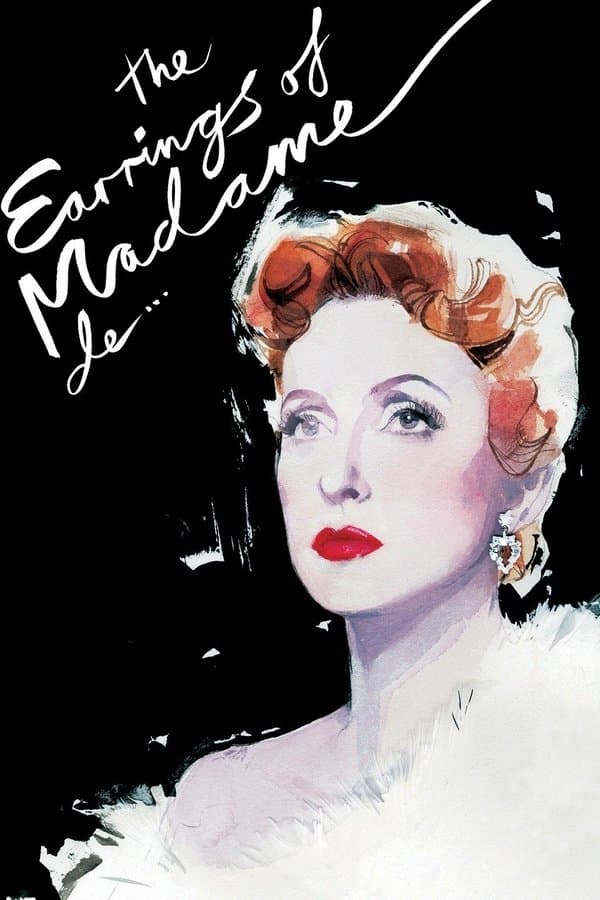
The Earrings of Madame de...
1953 • Drama, Romance
In late 19th century France, the Countess Louise, wife of a wealthy general, sells the earrings her husband gave her on their wedding day to pay off her secret debts, then claims to have lost them. Her husband quickly learns of the deceit, which is the beginning of many tragic misunderstandings, all involving the earrings, the general, the countess, and her new lover, the Italian Baron Donati.
Runtime: 1h 45m
Buy related books from Amazon
As an Amazon Associate I earn from qualifying purchases. Read the full disclosure.
Why you should read the novel
Before you stream The Earrings of Madame de..., read the source novel Madame de... by Louise de Vilmorin. This elegant, compact classic captures desire, deception, and social ritual in crystalline prose that reveals nuances no camera can fully show.
Reading Madame de... lets you experience high society from the inside. Vilmorin’s precise sentences, sly irony, and layered symbolism around the famous earrings deepen motives and consequences, making each turn of fate feel inevitable and freshly surprising.
If you love the movie, the book enriches the story with intimate psychology, witty observation, and literary texture perfect for book clubs and classic literature lovers. Choose to read Madame de... first and discover why this timeless tale began on the page.
Adaptation differences
Tone and perspective: Louise de Vilmorin’s novella is cool, elliptical, and slyly satirical, guided by a precise narrative voice. Max Ophüls’s film shifts the material toward lyrical romantic tragedy, replacing authorial irony with embodied emotion, performance, and music.
Characterization: The movie names and humanizes the principals—General André and Baron Fabrizio Donati—letting jealousy, pride, and longing unfold across dances and confrontations. On the page, figures are more emblematic, their calculations and self-deceptions rendered with icy brevity and a sharper satirical edge.
Structure and motifs: Both versions trace the earrings’ circulation, but the film expands episodes, adds ballroom sequences, and emphasizes religious imagery (including the sanctuary donation) to frame destiny. The novella compresses time and incident, favoring aphoristic beats and implication over elaborate set pieces.
Ending and moral shading: Ophüls culminates the affair in ceremonious confrontation and a sacramental coda that heightens doomed-romance pathos. Vilmorin’s resolution is leaner and more caustic, leaving a sharper social sting and greater ambiguity about guilt, innocence, and punishment.
The Earrings of Madame de... inspired from
Madame de...
by Louise de Vilmorin