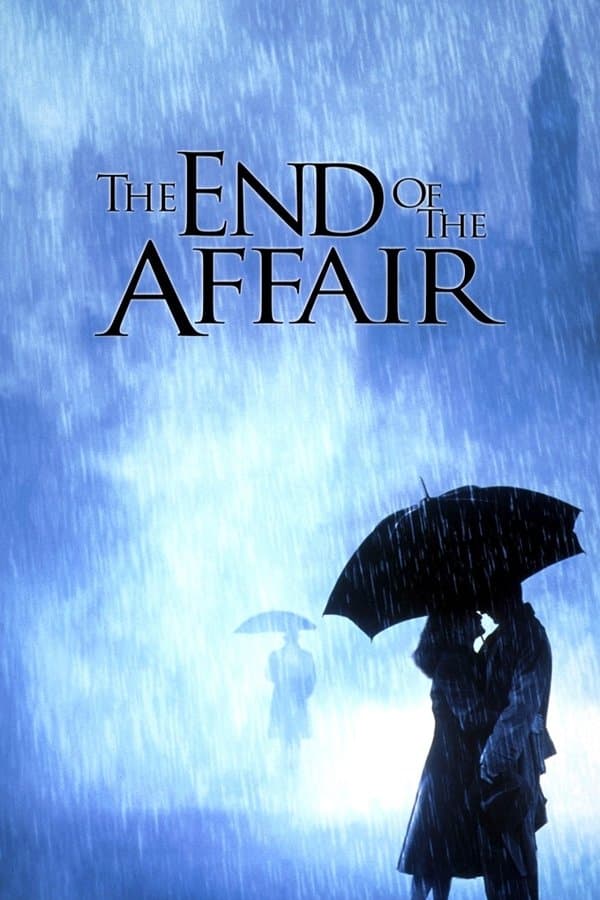
The End of the Affair
1999 • Drama, Romance • R
On a rainy London night in 1946, novelist Maurice Bendrix has a chance meeting with Henry Miles, husband of his ex-mistress Sarah, who abruptly ended their affair two years before. Bendrix's obsession with Sarah is rekindled; he succumbs to his own jealousy and arranges to have her followed.
Runtime: 1h 42m
Buy related books from Amazon
As an Amazon Associate I earn from qualifying purchases. Read the full disclosure.
Why you should read the novel
Before pressing play on the 1999 film, read Graham Greene’s The End of the Affair to experience the story as it was first imagined: intimate, searching, and morally complex. The novel’s confessional voice pulls you into a private world of jealousy, faith, and longing that a camera can only suggest. It’s a literary classic whose emotional power deepens with every page.
Greene’s prose turns wartime London into more than a backdrop—it becomes a crucible for conscience and love. Through Bendrix’s voice and Sarah’s own diary, the book reveals inner lives with a candor and precision no adaptation can fully capture. Readers discover motivations, contradictions, and spiritual battles that make the characters unforgettable.
If you value depth over spectacle, choose the book. The End of the Affair novel offers richer theology, sharper psychology, and a haunting ambiguity that invites reflection long after you close the final chapter. For book clubs, literature students, and classic fiction fans, Greene’s original is the definitive way to encounter this story.
Adaptation differences
The most immediate difference between the book and the 1999 movie is narrative perspective. Graham Greene’s novel is a first-person confession that folds in Sarah’s diary, creating layered, intimate access to two minds. The film, while evocative, necessarily streamlines this structure with selective voice-over and flashbacks, reducing the textured, shifting viewpoints that define the book’s power.
Theme and emphasis diverge as well. The novel dwells intensely on Catholic doubt, grace, and the uneasy coexistence of love and hate, using ambiguity to challenge the reader. The film foregrounds the romance and visual passion, placing more emphasis on sensual memory and melodrama than on the novel’s intricate theological wrestling.
Characterization is fuller on the page. Sarah’s interiority—her motives, promises, and spiritual fear—emerges directly in her diary in the book, while the film must imply much of it externally. Side figures like Henry, the private investigator Parkis, and the atheist lecturer Smythe carry more nuance and thematic weight in the novel, whereas the adaptation compresses their roles to maintain pace and focus.
Tone and ending also shift. Greene’s conclusion leaves Bendrix in a raw, unsettled struggle with belief and loss, an ambiguity that lingers uneasily. The film, though poignant, seeks a more romantic and visually cohesive closure and heightens physical intimacy and wartime spectacle. Where the novel’s restraint and unresolved prayer provoke meditation, the adaptation offers catharsis shaped by cinematic rhythm.
The End of the Affair inspired from
The End of the Affair
by Graham Greene