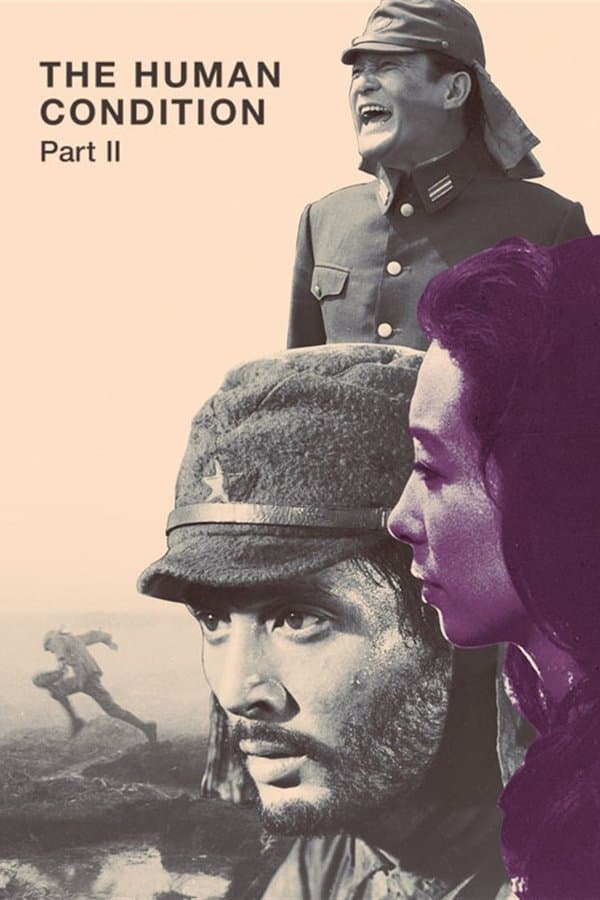
The Human Condition II: Road to Eternity
1959 • Drama, History, War
Kaji, sent to the Japanese army labeled Red, witnesses cruelties in the army and revolts against the abusive treatment against a fellow recruit. He also sees his friend Shinjô defecting to the Russian border, and he ends in the front to fight a lost battle against the Russian tanks division.
Runtime: 2h 58m
Buy related books from Amazon
As an Amazon Associate I earn from qualifying purchases. Read the full disclosure.
Why you should read the novel
Before you press play on The Human Condition II: Road to Eternity, consider reading Junpei Gomikawa’s monumental novel The Human Condition. On the page, Kaji’s internal conflicts, political convictions, and moral anguish unfold with a depth and nuance no screen can fully capture, transforming a powerful war story into a profound humanist reckoning.
Gomikawa’s six-volume epic immerses you in the psychological and ethical landscape of World War II-era Manchuria, exploring conscience, complicity, and survival under militarism. Through carefully rendered inner monologues and searing social critique, the book grants fuller access to Kaji’s evolving ideals and the complex people around him—moments the film necessarily compresses.
If you want the richest version of this story—its historical texture, ideological debates, and intimate emotional stakes—read the novel. Junpei Gomikawa’s The Human Condition is the definitive source material behind Masaki Kobayashi’s film, and it rewards every page with insight the adaptation can only suggest.
Adaptation differences
Scope and focus diverge significantly. The Human Condition II condenses the novel’s mid-volumes (often grouped in English discussions as “Road to Eternity”), merging training, front-line deployment, and retreat into a tighter arc. The book lingers on Kaji’s interiority—his humanist and left-leaning convictions, self-doubt, and ethical calculus—while the film externalizes this through action and terse dialogue.
Characterization is more expansive in print. Comrades and officers who appear briefly on screen are given richer backstories, shifting allegiances, and ideological shades in the novel. Kaji’s relationship with Michiko also resonates differently: letters, memories, and interior addresses sustain their bond across distance on the page, whereas the film streamlines or sidelines these domestic threads to keep momentum on battlefield events.
Events and wartime brutality are rendered with greater granularity in the book. Gomikawa details attrition, hunger, forced marches, reprisals, and moral compromise with documentary intensity. The film, shaped by runtime and visual constraints, compresses chronology, focalizes a handful of set pieces, and implies certain atrocities that the novel confronts directly, including the political dimensions of dissent within the ranks.
Structure and pacing diverge near the transition to captivity. In the novel, the section corresponding to “Road to Eternity” more gradually bridges the retreat and Kaji’s encounter with Soviet forces, offering connective tissue about geography, unit fragmentation, and psychological collapse. The film closes on a dramatic inflection to set up Part III, simplifying transfers, merging minor figures, and accelerating timelines for cinematic clarity.
The Human Condition II: Road to Eternity inspired from
The Human Condition
by Junpei Gomikawa