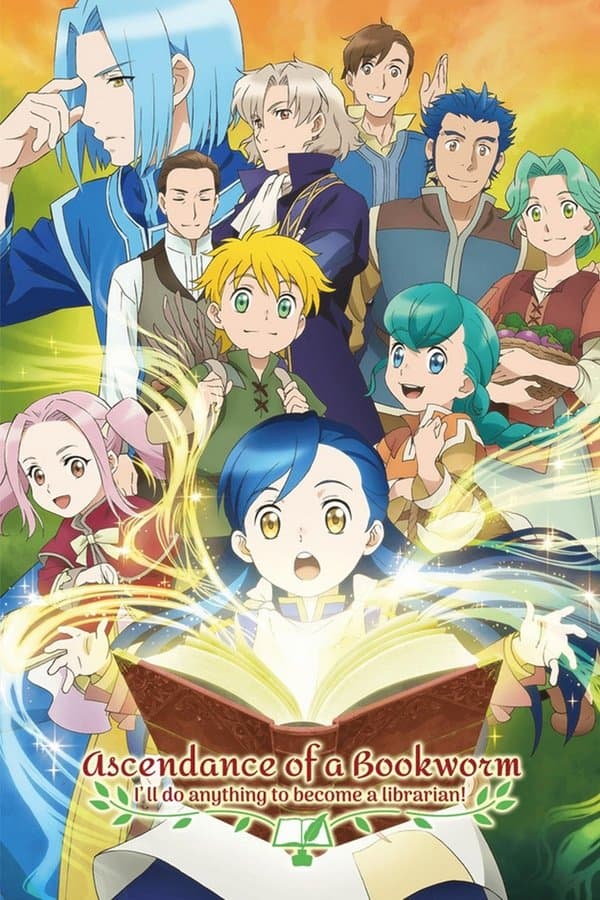
Ascendance of a Bookworm
2019 • Animation, Drama, Sci-Fi & Fantasy • TV-14
When a sickly young girl suddenly becomes obsessed with inventing new things, her family and friends are all puzzled. "What has gotten into Myne?" they wondered, never dreaming that the answer is not a "What" but a "Who": Urano Motosu, a book-loving apprentice librarian who died in an earthquake in Tokyo who somehow found herself in Myne's body! And since Myne's world is still in a medieval stage, where books can only be owned by the elite, the new Myne intends to do everything she can to bring her beloved books to the masses in the time she has left.
Buy related books from Amazon
As an Amazon Associate I earn from qualifying purchases. Read the full disclosure.
Why you should read the novel
If you're captivated by the world of Ascendance of a Bookworm, the original light novels by Miya Kazuki offer an even deeper and richer experience. The books contain intricate descriptions of society, customs, and the protagonist's inventive ideas that go far beyond what the anime can show. By reading the novels, you'll discover additional plotlines, detailed inner thoughts, and nuanced character interactions that are only briefly touched upon—or completely omitted—in the TV series.
Exploring the novels allows you to fully appreciate Myne's creativity and determination as she navigates a medieval society where books are precious and knowledge is power. These volumes provide fascinating insights into the complexities of book production, the socioeconomic landscape, and Myne’s persistence in overcoming adversity, making her journey even more inspirational on the page.
Moreover, the light novels deliver a more immersive, personal perspective on Myne’s aspirations, frustrations, and dreams. For lovers of fantasy and books, delving into the source material is the best way to connect with the heart and soul of this story—a heartfelt tribute to the love of reading that will resonate long after the last page.
Adaptation differences
One of the main differences between the Ascendance of a Bookworm TV series and the novels is the depth of world-building and exposition. The novels provide extensive explanations of the setting, customs, and Myne’s inventions, which are often compressed or shortened in the anime for time and pacing. Readers gain a better understanding of the technological and societal limitations Myne faces, making her accomplishments feel even more significant.
Characterization and internal monologue are also more robust in the books. The novels dedicate more space to Myne’s introspection, her anxieties about her frail body, and her considerate tactics as she interacts with new people and institutions. These subtleties are sometimes lost or simplified in the show, where internal struggles may only be briefly shown through narration or facial expressions.
The pacing differs considerably. The novels progress slowly, allowing for the steady accumulation of detail and gradual evolution of relationships, whereas the anime often condenses events to maintain viewer engagement. Some side stories and minor characters receive more attention in the novels, enriching the tapestry of Myne's world in ways the adaptation cannot replicate within its limited episode count.
Finally, certain scenes are either omitted or altered for the TV series to fit the visual medium, including some of Myne’s most creative endeavors or challenges. These missing or rearranged moments can have a notable impact on the story’s nuance and the emotional connection readers develop with the cast. The light novels, by including these episodes, afford fans the most complete and satisfying version of Myne's journey.
Ascendance of a Bookworm inspired from
Ascendance of a Bookworm: I’ll Do Anything to Become a Librarian!
by Miya Kazuki