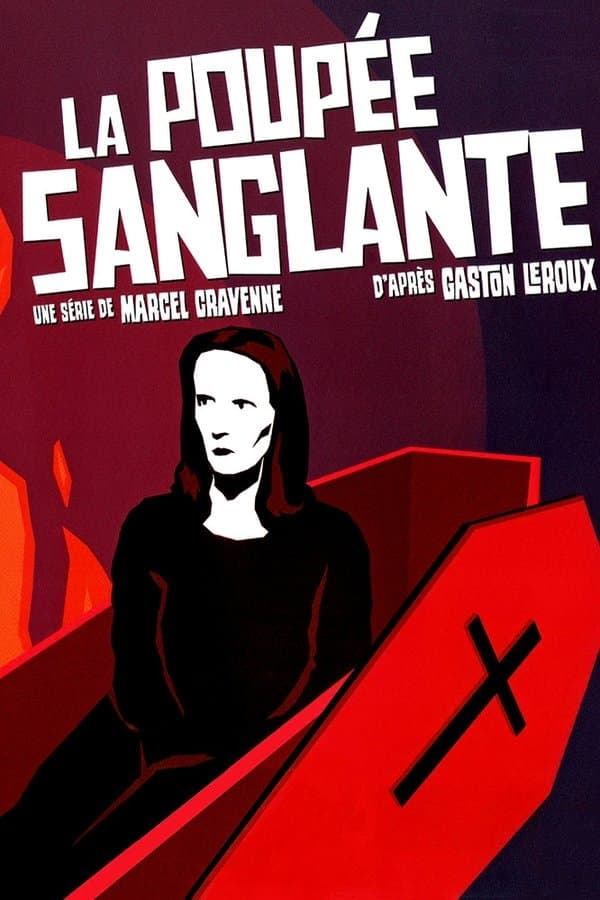
La Poupée sanglante
1976 •
Paris, 1925. Bénédict Masson, bookbinder and poet, is secretly in love with his neighbor, Christine. Christine works at the strange Coulteray mansion where the marquise accuses her husband of being a vampire. But Bénédict has other preoccupations: six of his apprentices have disappeared without a trace.
Buy related books from Amazon
As an Amazon Associate I earn from qualifying purchases. Read the full disclosure.
Why you should read the novels
Discover the original vision behind La Poupée sanglante by reading Gaston Leroux’s novels The Bloody Doll and The Machine to Kill. These English editions deliver Leroux’s inventive blend of Gothic mystery, romantic obsession, and proto-science fiction with the nuance only prose can provide.
On the page, Leroux unfolds the Belle Époque world with layered psychology, sly social satire, and meticulous clues that reward attentive readers. You will experience the suspense from the inside out, guided by intimate viewpoints, unreliable testimonies, and eloquent atmospheric detail that television can only hint at.
If you loved the miniseries, the books offer deeper motivations, bolder twists, and richer themes about identity, technology, and morality. Read the source novels to appreciate every turn of Leroux’s puzzle-box plotting and savor the full power of his classic French storytelling.
Adaptation differences
The 1976 TV series La Poupée sanglante condenses and blends material from The Bloody Doll and The Machine to Kill into a single continuous arc. To fit episodic structure, events are reordered, subplots are trimmed, and some roles are merged, shifting emphasis from investigative detail to atmosphere and romance.
Gaston Leroux’s novels devote significant space to inner monologues, press reports, and procedural clues that shape reader suspicion. The adaptation largely externalizes these elements through dialogue and staging, reducing the novels’ layered narration, competing testimonies, and slow-burn revelations in favor of clearer, faster exposition.
Tone also shifts: the books lean into macabre speculation and philosophical questions about identity, the body, and responsibility, while the series foregrounds Gothic mood and melodramatic tension. Television standards of the 1970s soften certain grisly or morally ambiguous passages, altering the intensity of the horror and ethical ambiguity present in the text.
Finally, continuity and closure differ. Leroux’s two-part saga uses the second novel to reframe mysteries and expand consequences from the first. The miniseries aims for a more self-contained resolution within limited episodes, simplifying some scientific concepts and streamlining late-book twists to provide a coherent conclusion for viewers.
La Poupée sanglante inspired from
The Machine to Kill
by Gaston Leroux
The Bloody Doll
by Gaston Leroux