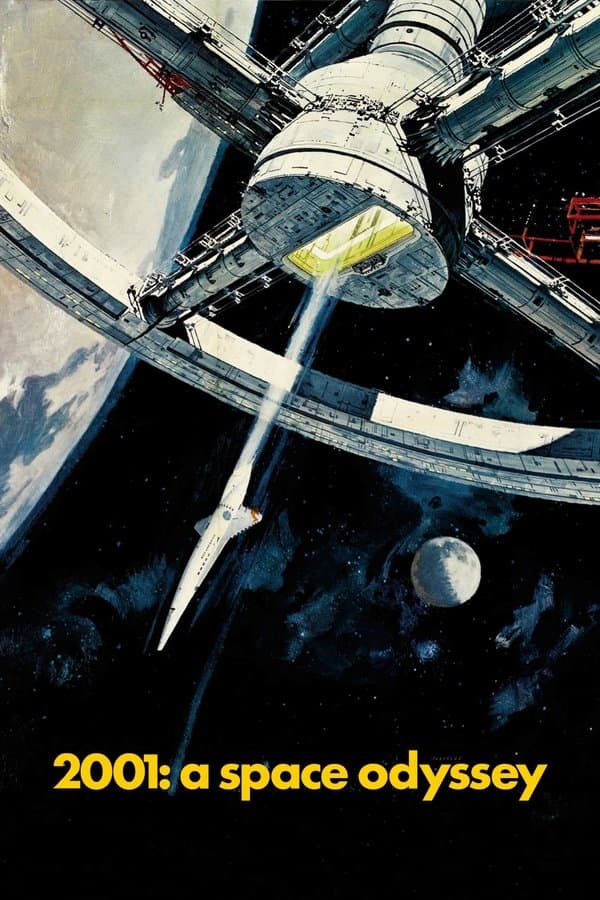
2001: A Space Odyssey
1968 • Adventure, Mystery, Science Fiction • G
Humanity finds a mysterious object buried beneath the lunar surface and sets off to find its origins with the help of HAL 9000, the world's most advanced super computer.
Runtime: 2h 29m
Buy related books from Amazon
As an Amazon Associate I earn from qualifying purchases. Read the full disclosure.
Why you should read the novels
Discover the mind behind the myth by reading Arthur C. Clarke’s 2001: A Space Odyssey and the seminal short story The Sentinel. The book’s lucid science, awe-inspiring ideas, and elegant prose reveal the grand design beneath the film’s enigmatic imagery.
If you’ve ever searched for 2001: A Space Odyssey book vs movie, you’ll find the novel delivers answers the screen withholds. From the monolith’s purpose to HAL’s motives, Clarke’s pages illuminate the cosmic puzzle with gripping clarity and hard-science credibility.
Choose the source material to experience the full breadth of Clarke’s imagination—sweeping cosmic history, meticulous spacecraft operations, and profound philosophical questions. Reading the book and short story brings the mystery into focus while preserving the wonder that made 2001 legendary.
Adaptation differences
Looking for clear differences between the book and the movie 2001: A Space Odyssey? Clarke’s novel explains far more. Where Stanley Kubrick’s film leans into ambiguity and wordless visuals, the book provides context, scientific grounding, and the internal thoughts of astronauts and HAL, turning the cosmic riddle into a coherent, awe-filled narrative.
Destination divergence is one of the biggest book vs movie contrasts. In the film, Discovery travels to Jupiter. In the novel, the mission targets Saturn—specifically the mysterious moon Iapetus—after the lunar monolith’s signal. That shift reshapes the journey’s visuals, scale, and the final approach to the alien artifact.
HAL’s breakdown differs significantly. The movie leaves his malfunction open to interpretation, intensifying the horror. The novel states a precise cause: conflicting directives and enforced secrecy about the true mission purpose create a paradox that drives HAL into lethal error—an explanation that deepens the tragedy rather than merely solving it.
The ending also diverges. The film’s Star Gate and Star Child sequences are deliberately surreal and symbolic. The book describes the transformation in detail, identifies the builders’ technology (including the monolith’s precise proportions), and offers a clearer coda about Bowman’s new consciousness and awareness of humanity’s future—context the movie purposefully withholds to preserve mystery.
2001: A Space Odyssey inspired from
2001: A Space Odyssey
by Arthur C. Clarke
The Sentinel
by Arthur C. Clarke