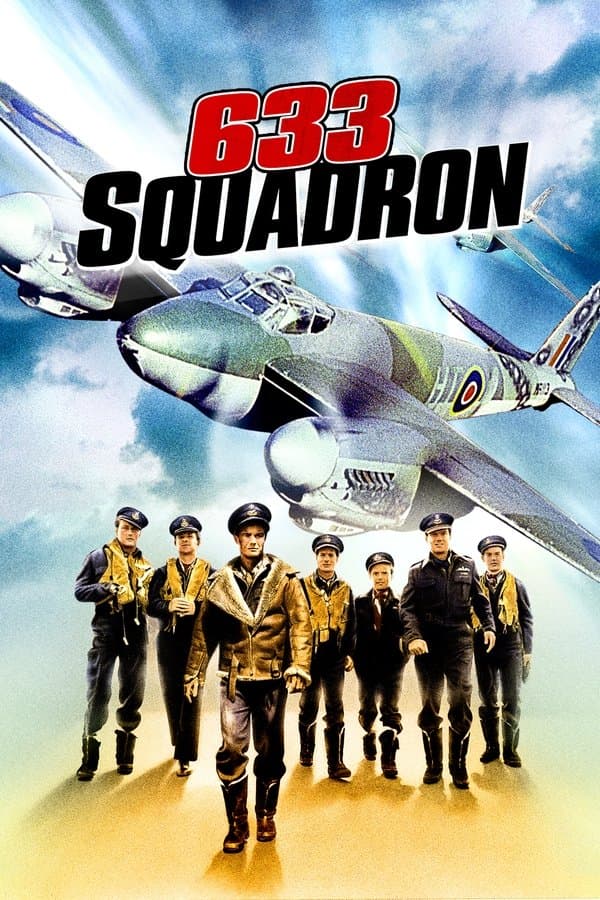
633 Squadron
1964 • Drama, War • PG
When Norwegian resistance leader Lieutenant Erik Bergman reports the location of a German V-2 rocket fuel plant, the Royal Air Force's 633 Squadron is assigned the mission to destroy it. The plant is in a seemingly-impregnable location beneath an overhanging cliff at the end of a long, narrow fjord lined with anti-aircraft guns. The only way to destroy the plant is by collapsing the cliff on top of it.
Runtime: 1h 42m
Buy related books from Amazon
As an Amazon Associate I earn from qualifying purchases. Read the full disclosure.
Why you should read the novel
Before you cue up the film, discover Frederick E. Smith’s original 633 Squadron novel for a deeper, more authentic World War II aviation experience. Smith’s research-driven storytelling, cockpit realism, and tightly observed unit dynamics place you inside the Mosquito, where every decision carries life-or-death weight.
Reading the book reveals richer character arcs and motivations that the movie can only hint at. You’ll follow pilots, ground crew, and resistance allies across training, planning, and combat with nuance—gaining emotional stakes that elevate the climactic raid far beyond spectacle.
If you love WWII air combat fiction, 633 Squadron is essential reading. The novel’s immersive details, moral complexity, and tense pacing deliver the full story—perfect for readers who want to understand the mission before, during, and after the moments the camera captures.
Adaptation differences
The film streamlines the novel’s broader ensemble and compresses multiple subplots into a tighter, mission-first arc. On the page, secondary pilots, ground crew, and resistance contacts receive greater development, backstory, and inner conflict, lending the operation a layered, lived-in texture that the adaptation trims for pace.
Aviation and tactical specifics are more granular in the book. Smith’s chapters dwell on planning, low-level navigation, weapons loads, and the engineering rationale behind triggering a landslide in the fjord. The movie condenses training and rehearsal sequences, simplifies the geography, and prioritizes visual momentum over the novel’s step-by-step operational detail.
Tone also shifts between mediums. Where the film highlights rousing heroism, a prominent romantic thread, and a clean narrative spine, the novel sustains a more somber, workmanlike atmosphere—emphasizing fatigue, attrition, and the psychological grind. Some character roles are merged or adjusted, and relationships are reframed to fit the film’s runtime and emphasis on a single commanding lead.
Outcomes and emphasis differ as well. The novel spreads tension across preliminary sorties and aftermath, while the movie concentrates suspense in the final raid. Casualties, timing, and the extent of resistance cooperation are portrayed with different emphases, and the book’s broader operational context provides consequences and coda moments largely abbreviated on screen.
633 Squadron inspired from
633 Squadron
by Frederick E. Smith