Affliction
1998 • Crime, Drama, Mystery, Thriller • R
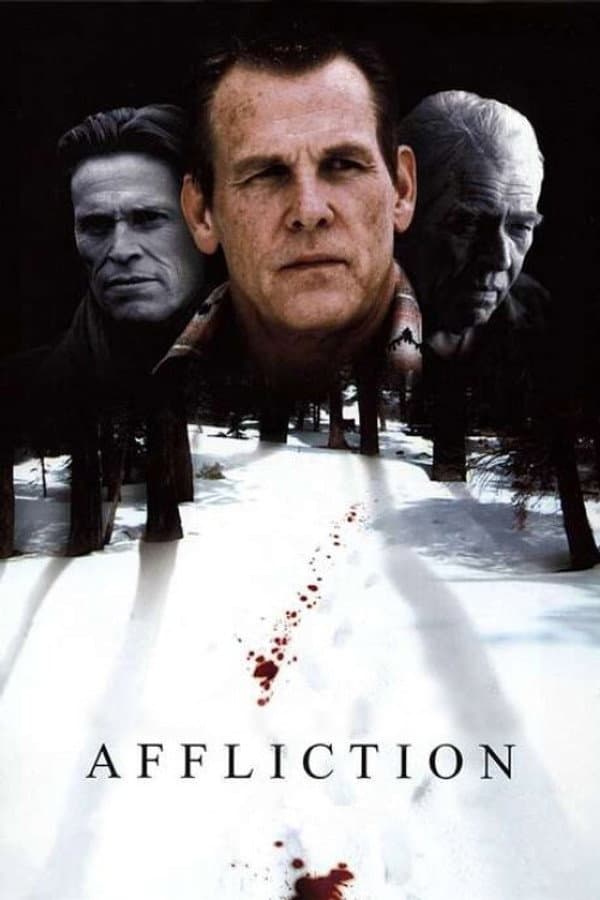
A small town policeman must investigate a suspicious hunting accident. The investigation and other events result in him slowly disintegrating mentally.
Runtime: 1h 54m
Buy related books from Amazon
As an Amazon Associate I earn from qualifying purchases. Read the full disclosure.
Why you should read the novel
Before pressing play, consider opening Russell Banks’s Affliction, the searing source novel behind the film. The book’s stark New England setting, raw interiority, and layered moral tensions are experienced most vividly on the page, where every silence and hesitation gains meaning.
Reading the Affliction novel gives you sustained access to the characters’ troubled histories and motives, especially Wade Whitehouse’s unraveling mind and the generational scars shaping him. Banks’s precise, compassionate prose turns small-town life, family trauma, and suspicion into a powerful literary experience you simply can’t replicate on screen.
If you’re searching for a deeper exploration of themes the movie only hints at—memory, masculinity, violence, and shame—start with the book. This acclaimed Russell Banks novel offers richer context, greater psychological nuance, and an unforgettable voice that makes the story’s tragedy resonate long after the last page.
Adaptation differences
One of the most important differences between the Affliction movie and the book is narrative perspective. Russell Banks’s novel is framed and filtered through Wade’s brother, Rolfe Whitehouse, whose reflective, sometimes unreliable narration shapes how we interpret events. The film, by contrast, centers visually on Wade’s immediate experience, using Rolfe’s voice-over sparingly. That shift narrows the story’s ambiguity and changes how we assign meaning and blame.
The book provides broader psychological depth and a fuller family history. Banks painstakingly traces childhood abuse, learned behaviors, and the long shadow of generational trauma across siblings and parents. The movie necessarily compresses timelines and interior monologue, externalizing conflict into scenes and confrontations. As a result, subtleties about memory, denial, and the social forces around the Whitehouse family are more thoroughly developed in the novel than on screen.
Plot emphasis also diverges. The Russell Banks novel spends more time on the investigation surrounding the hunting “accident,” local power structures, and small-town politics, letting suspicion build gradually and remain productively ambiguous. The Paul Schrader adaptation streamlines these elements to focus on Wade’s deterioration and the father–son dynamic, giving the film a tighter, more immediate arc while the book sustains a wider web of motives and possibilities.
Tone and resolution differ as well. The novel’s voice—meditative, elegiac, and self-questioning—leaves readers with unresolved questions that invite interpretation. The film delivers more visceral, dramatic confrontations and trims or minimizes certain secondary characters and subplots to maintain momentum. Readers who want the most complete picture of themes, context, and character psychology will find the book’s scope and ambiguity distinct from, and deeper than, the movie’s powerful but more concentrated approach.
Affliction inspired from
Affliction
by Russell Banks