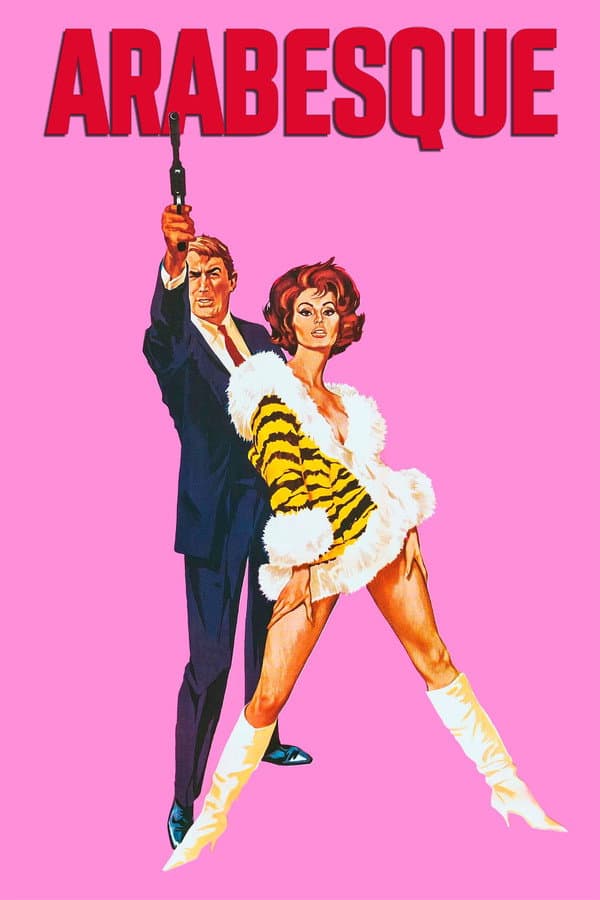
Arabesque
1966 • Action, Comedy, Mystery, Thriller
When a plot against a prominent Middle Eastern politician is uncovered, David Pollock, a professor of ancient hieroglyphics at Oxford University, is recruited to help expose the scheme. Pollock must find information believed to be in hieroglyphic code and must also contend with a mysterious man called Beshraavi. Meanwhile, Beshraavi's lover, Yasmin Azir, seems willing to aid Pollock -- but is she really on his side?
Runtime: 1h 45m
Buy related books from Amazon
As an Amazon Associate I earn from qualifying purchases. Read the full disclosure.
Why you should read the novel
Before you press play on Arabesque (1966), discover the source that sparked its intrigue: The Cypher by Alex Gordon. This brisk, elegantly plotted espionage novel delivers brainy code-breaking, tightening suspense, and a sophisticated geopolitical backdrop that the screen can only hint at. If you love classic spy fiction, the book’s sharper stakes and richer atmosphere are a treat.
Reading The Cypher puts you inside the protagonist’s mind as the puzzle unfolds, offering layered motivations, moral ambiguities, and a satisfying trail of misdirection. You’ll get clarity on the who, why, and how behind the mystery, with nuanced character work that deepens every twist. It’s the kind of immersive detail movie adaptations struggle to fit into two stylish hours.
For fans of John le Carré, Eric Ambler, and mid-century thrillers, The Cypher blends cerebral codes with authentic espionage tradecraft. Choose the book to experience the original vision: more depth, more texture, and a timeless page-turner that rewards careful reading and leaves a lasting impression.
Adaptation differences
Tone and emphasis shift notably from page to screen. The Cypher is a taut, grounded espionage novel centered on decoding and strategy, whereas Arabesque tilts toward a playful, romantic caper energy. The film favors glamorous set pieces, witty byplay, and visual flair; the novel leans into tension, logic, and the steady pressure of geopolitical stakes.
Characterization is more restrained and interior in the book. The novel’s protagonist is a scholarly codebreaker first and reluctant operative second, with thoughts and doubts the film can only sketch. Yasmin’s motives read more opaque and morally ambiguous on the page, while Beshraavi is dangerous without the heightened eccentricities emphasized in the movie. Arabesque amplifies charm, repartee, and fashion-forward mystique, streamlining inner conflicts into on-screen chemistry.
Plot mechanics and the cipher itself are reimagined for the adaptation. The Cypher focuses on a traditional code-based puzzle and methodical tradecraft, while Arabesque reframes the mystery around an Egyptology-flavored riddle that suits a faster, more kinetic narrative. The film compresses and simplifies political context to keep momentum high, substituting elaborate chases and gags for the book’s incremental, clue-by-clue revelations.
Setting and pacing also diverge. The novel spends more time in austere academic corridors and the shadowy edges of Middle Eastern power politics, building unease in measured beats. Arabesque relocates much of the action to Oxford and London, embracing a chic, swinging-’60s palette and momentum-driven sequences. The book’s resolution lands with a more sober, morally shaded impact, while the film wraps with a cleaner, more exuberant flourish.
Arabesque inspired from
The Cypher
by Alex Gordon (Gordon Cotler)