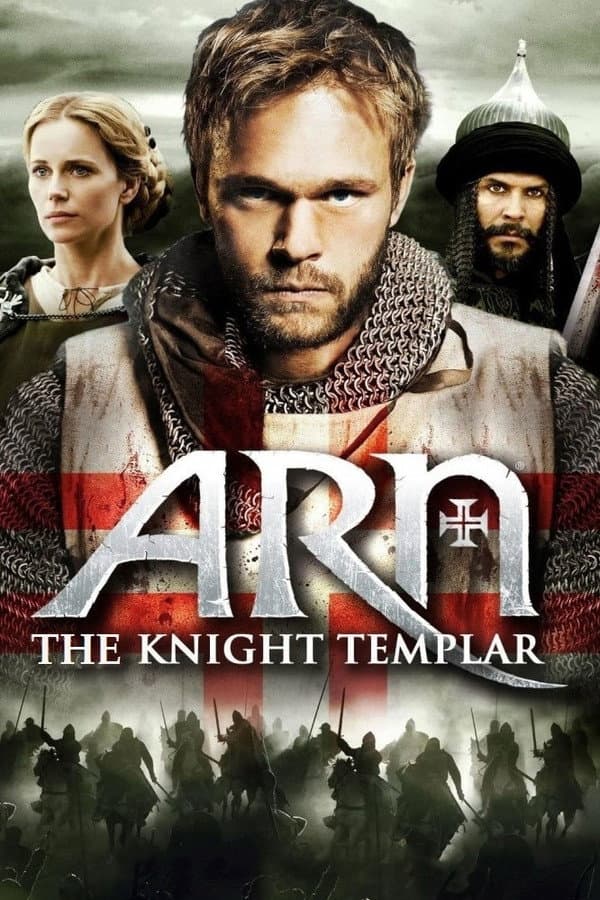
Arn: The Knight Templar
2007 • Action, Adventure, Drama, Romance • PG-13
Arn, the son of a high-ranking Swedish nobleman is educated in a monastery and sent to the Holy Land as a knight templar to do penance for a forbidden love.
Runtime: 2h 19m
Buy related books from Amazon
As an Amazon Associate I earn from qualifying purchases. Read the full disclosure.
Why you should read the novels
If Arn: The Knight Templar intrigued you, the definitive way to experience his story is in Jan Guillou’s Crusades trilogy: The Road to Jerusalem, The Knight Templar, and The Kingdom at the End of the Road. The novels deliver the full arc of Arn Magnusson’s life with layers of historical detail, emotional nuance, and cultural texture that no two-hour film can match.
On the page, you’ll explore the forces shaping medieval Scandinavia—clan loyalties, church power, and the fragile path toward a unified Sweden—alongside the spiritual and martial disciplines that forge Arn into a knight. Guillou’s research-driven storytelling immerses you in monasteries, training yards, trade routes, and the diverse world of the Holy Land, offering a balanced view of Christians and Muslims alike.
Readers who love historical fiction will find rich characters, political intrigue, and thought-provoking questions about honor, faith, and love. If you want a complete, authentic journey—with relationships and rivalries that unfold over years—read the Arn books first and let the movie be a visual companion afterward.
Adaptation differences
Scope and pacing are the clearest differences between the movie and the books. The film streamlines years of Arn’s upbringing, monastic education, and knighthood into a compact arc focused on romance and battlefield spectacle. The novels unfold deliberately, tracing how discipline, language training, and spiritual formation shape Arn’s identity long before he ever rides to war.
The Swedish setting is far more intricate in the books. Guillou dives deep into the rivalry between powerful clans, church politics, and the legal-religious consequences that drive Arn and Cecilia’s separation. The film reduces this complexity, condensing legal proceedings and downplaying the social fabric and ecclesiastical power plays that define much of Arn’s fate on the page.
Life in the Holy Land is also portrayed differently. The movie favors duels, chases, and set-piece battles, while the novels emphasize logistics, strategy, and daily routines of a knightly order—patrols, fortifications, diplomacy, and cultural exchange. Arn’s relationship with Muslim leaders, including a bond of mutual respect, is more layered and gradual in the books; on screen it’s simplified into a symbolic shorthand to keep momentum.
Character depth and resolution diverge as well. Supporting figures—mentors, abbots, nobles, and family members—receive fuller arcs and motivations in the novels, shaping Arn’s moral and strategic choices. The film compresses or merges roles to keep the plot moving, and it leans into immediate emotional payoffs, whereas the books chart long-term consequences and a broader nation-building vision that culminates in Arn’s return and legacy.
Arn: The Knight Templar inspired from
The Knight Templar
by Jan Guillou
The Road to Jerusalem
by Jan Guillou
The Kingdom at the End of the Road
by Jan Guillou