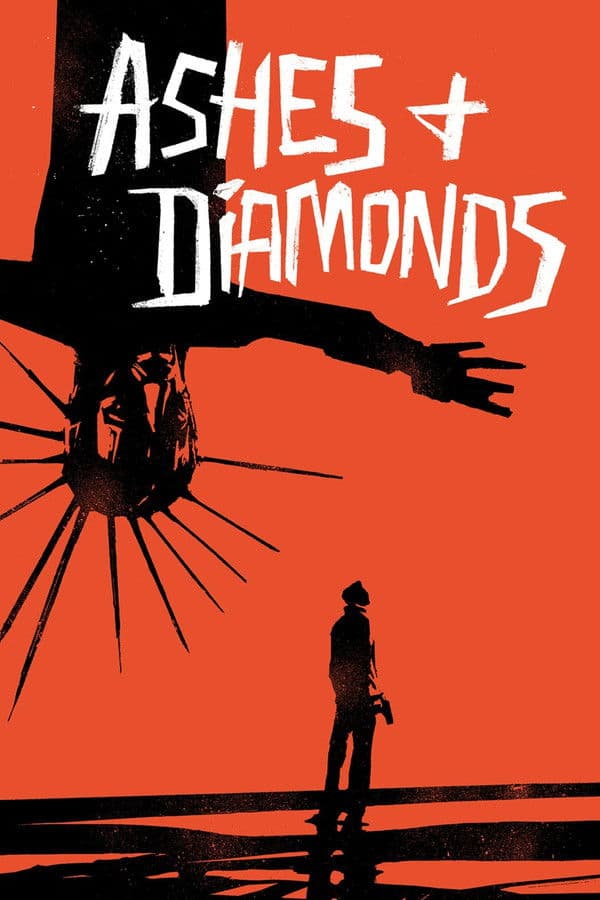
Ashes and Diamonds
1958 • Drama, Romance, War
A young academy soldier, Maciek Chelmicki, is ordered to shoot the secretary of the KW PPR. A coincidence causes him to kill someone else. Meeting face to face with his victim, he gets a shock. He faces the necessity of repeating the assassination. He meets Krystyna, a girl working as a barmaid in the restaurant of the "Monopol" hotel. His affection for her makes him even more aware of the senselessness of killing at the end of the war. Loyalty to the oath he took, and thus the obligation to obey the order, tips the scales.
Runtime: 1h 43m
Buy related books from Amazon
As an Amazon Associate I earn from qualifying purchases. Read the full disclosure.
Why you should read the novel
Discover Ashes and Diamonds as Jerzy Andrzejewski originally wrote it, a landmark of Polish literature that immerses you in the complex moral and political tensions of 1945. Reading the novel reveals layers of context, inner conflict, and historical nuance the screen can only suggest, making it an essential choice for serious readers of literary fiction and European history.
The Ashes and Diamonds book offers a richer tapestry of voices, subplots, and philosophical debate than any adaptation. By experiencing the source material, you gain direct access to Andrzejewski’s themes, character psychology, and narrative design—crucial for understanding how ideology, loyalty, and personal desire collide at the exact moment a new order takes shape.
If you are deciding between watching the movie or reading the book, choose the Ashes and Diamonds novel by Jerzy Andrzejewski for the most complete story. In English editions—whether ebook, paperback, or audiobook—you get the authoritative version of this modern classic, ideal for book clubs, academic study, and readers seeking compelling, thought‑provoking World War II–era fiction.
Adaptation differences
Key differences between the Ashes and Diamonds movie and the book begin with scope and structure. Andrzejewski’s novel casts a wider net, following multiple storylines and social layers over a longer span, while the film compresses events into an intense, nearly real‑time crucible. The movie merges or trims supporting characters and subplots to concentrate on a taut narrative centered on Maciek, the assassination plot, and the night of celebration and reckoning.
Tone and ideological emphasis also diverge. Written in 1948, the novel reflects postwar debates in Poland and presents the Communist official Szczuka with pronounced sympathy while viewing underground assassins as tragically misguided. Made in 1958, the Andrzej Wajda film—shaped by the post‑Stalinist thaw—casts Maciek as a more romantic, existential antihero and softens overt didactic elements, creating a more ambivalent, human‑scale tragedy.
Characterization and point of view shift from page to screen. The book grants deeper interior access to multiple figures—Maciek, Szczuka, Krystyna, and bureaucrats like Drewnowski—through reflection and dialogue. The film necessarily externalizes motives, relying on performance and action, with Zbigniew Cybulski’s star persona giving Maciek a rebellious, modern edge. Krystyna’s arc is streamlined into an emblematic love story, and Szczuka’s backstory and familial threads are more condensed than in the novel.
Imagery and endings further distinguish the adaptation. The movie introduces indelible visual symbols—flaming vodka glasses, stark ruins, fireworks, and the spectral white horse—to express themes the novel develops through narration and ideas. While both versions end in tragedy, the film’s closing moments emphasize visceral, solitary loss, whereas the book provides broader sociopolitical context and reflection on the consolidation of the new regime, underscoring the historical consequences beyond an individual fate.
Ashes and Diamonds inspired from
Ashes and Diamonds
by Jerzy Andrzejewski