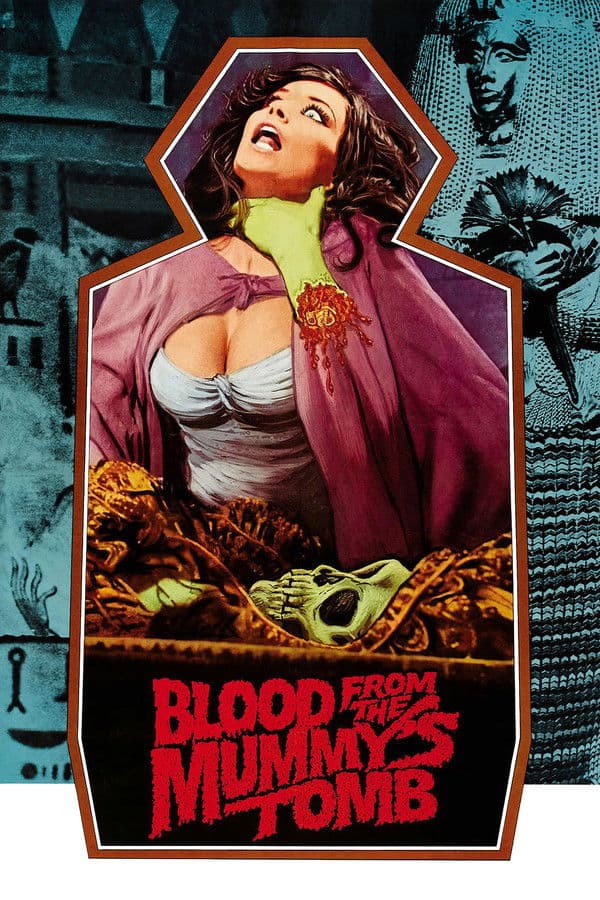
Blood from the Mummy's Tomb
1971 • Horror • PG
Two Egyptologists, Professor Fuchs and Corbeck, are instrumental in unleashing unmitigated horror by bringing back to England the mummified body of Tara, the Egyptian Queen of Darkness. Fuchs’s daughter becomes involved in a series of macabre and terrifying incidents, powerless against the forces of darkness, directed by Corbeck, that are taking possession of her body and soul to fulfill the ancient prophesy that Queen Tara will be resurrected to continue her reign of unspeakable evil.
Runtime: 1h 34m
Buy related books from Amazon
As an Amazon Associate I earn from qualifying purchases. Read the full disclosure.
Why you should read the novel
Before you watch Blood from the Mummy's Tomb (1971), read Bram Stoker's The Jewel of Seven Stars, the haunting source novel that powers Hammer's Egyptian horror. Stoker's book delivers layered archaeology, occult ritual, and mounting dread that the movie can only glimpse.
The novel offers a richer experience: textured Egyptology, intimate psychology, and a slow-burn mystery that rewards careful reading. You get the original vision behind the film, with deeper context for Queen Tera, the expedition, and the eerie preparations for resurrection.
Crucially, Stoker published two different endings across editions, giving readers alternate conclusions the film cannot provide. The Jewel of Seven Stars is widely available in print and ebook, making it easy to explore the definitive source behind the cult movie.
Adaptation differences
Setting and structure diverge significantly. Stoker’s novel unfolds in late Victorian or Edwardian England with a first-person narrator, Malcolm Ross, blending investigation, diaries, and testimony. The 1971 Hammer film updates the action to contemporary London and drops the epistolary frame, focusing instead on immediate, dreamlike horror.
Characters are condensed and renamed. In the book, the central figures include Abel Trelawny, his daughter Margaret, Eugene Corbeck, Dr. Winchester, and narrator Malcolm Ross. The film reimagines the family as Professor Fuchs and his daughter Margaret, removes Malcolm as narrator, and streamlines supporting roles to center Margaret’s connection to Queen Tera.
Tone and plot mechanics shift. The novel balances detective elements with occult procedure, lingering on scholarship, artifact study, and the ethics of revivification. The film amplifies supernatural possession, visions, and a string of violent deaths as artifacts are reclaimed, turning the story into a more immediate, sensational thriller.
Endings and themes differ sharply. Stoker’s book exists in two versions: the 1903 edition ends catastrophically, while the 1912 revision offers a more conciliatory resolution and romantic closure. The movie chooses an apocalyptic, ambiguous ritual climax, eschewing the novel’s dual-ending tradition and the extended romantic arc between Margaret and Malcolm.
Blood from the Mummy's Tomb inspired from
The Jewel of Seven Stars
by Bram Stoker