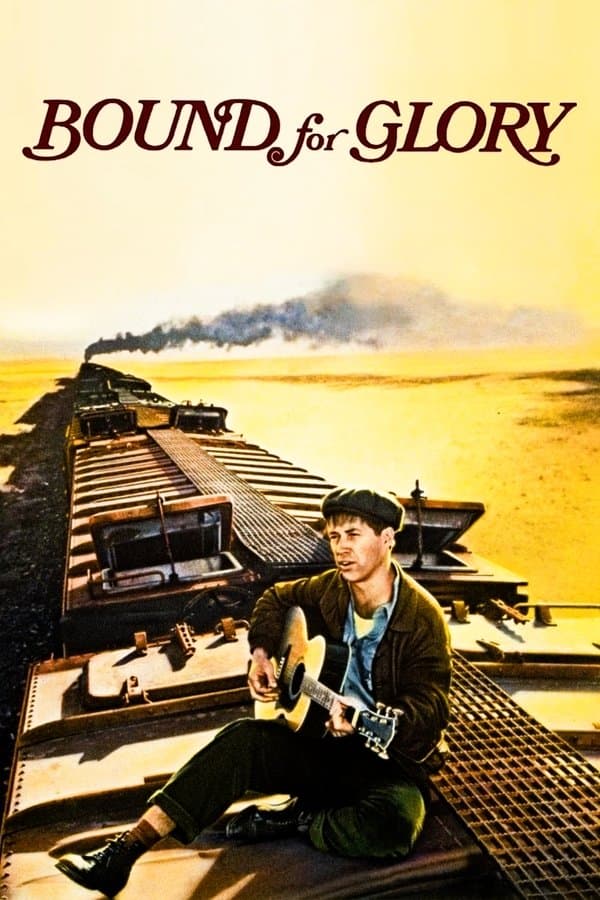
Bound for Glory
1976 • Drama, Music
A biography of Woody Guthrie, one of America's greatest folk singers. He left his dust-devastated Texas home in the 1930s to find work, discovering the suffering and strength of America's working class.
Runtime: 2h 27m
Buy related books from Amazon
As an Amazon Associate I earn from qualifying purchases. Read the full disclosure.
Why you should read the novel
Before you watch the 1976 movie Bound for Glory, read the source book Bound for Glory by Woody Guthrie. This vivid autobiography drops you directly into the Dust Bowl, onto rattling boxcars, and inside migrant camps—guided by Guthrie’s own voice.
As a firsthand account, the book offers raw honesty, humor, and poetry the screen can’t fully capture. You’ll experience Guthrie’s hardscrabble travels, evolving politics, and musical awakening with the immediacy of a journal, not a reenactment.
If you care about American history, folk music, and the Great Depression, reading Bound for Glory is essential. Discover the original words that inspired the film and understand Woody Guthrie’s legacy from the only perspective that truly matters—his own.
Adaptation differences
Scope and timeline: The Bound for Glory movie focuses on Guthrie’s Dust Bowl migration to California and his early radio break, while the book ranges far wider—covering Oklahoma and Texas childhood, wanderings, sign-painting gigs, and formative family history largely absent on screen.
Voice and structure: The film presents an external, observational narrative; the book is a first-person, slangy, and poetic autobiography that blends storytelling, sharp humor, and folk wisdom. Guthrie’s internal monologues, riffs, and digressions—central to the book’s personality—are necessarily reduced or transformed into visuals in the adaptation.
Characters and events: To streamline the story, the movie condenses chronology and introduces composite or fictionalized figures, simplifying relationships and union episodes. The book offers messier, episodic encounters and fuller context for Guthrie’s labor activism, travels, and day-to-day hustles that the film abbreviates for narrative momentum.
Music and politics: On the page, lyrics, prose-poems, and political reflections appear in Guthrie’s own words; on screen, these become curated performances and set pieces. The film emphasizes performances and key moments, while the book provides broader ideological nuance, more granular detail on organizing, and the cumulative texture of a life lived on the move.
Bound for Glory inspired from
Bound for Glory
by Woody Guthrie