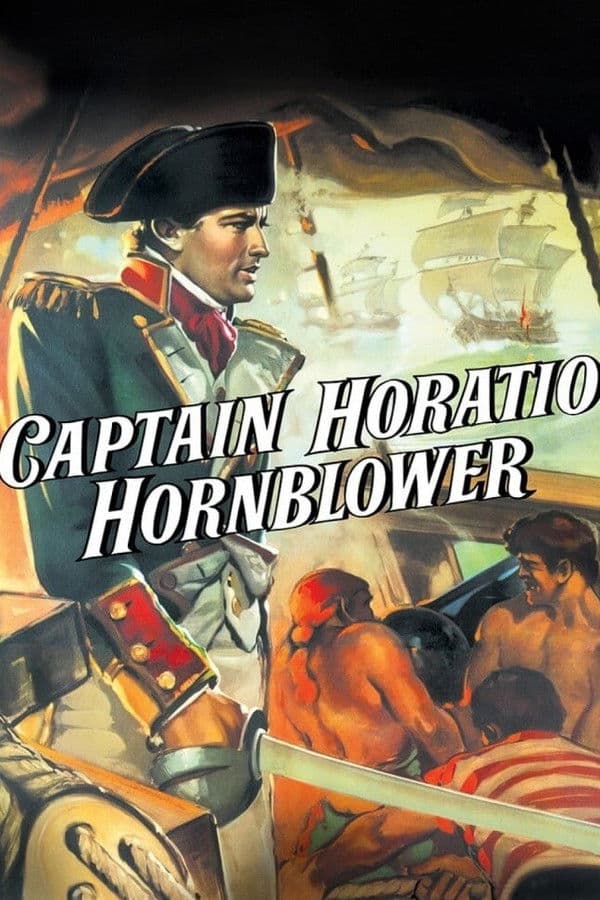
Captain Horatio Hornblower R.N.
1951 • Adventure, History, War • NR
Captain Horatio Hornblower leads his ship HMS Lydia on a perilous transatlantic voyage, during which his faithful crew battle both a Spanish warship and a ragged band of Central American rebels.
Runtime: 1h 57m
Buy related books from Amazon
As an Amazon Associate I earn from qualifying purchases. Read the full disclosure.
Why you should read the novels
If Captain Horatio Hornblower R.N. thrilled you, the original Horatio Hornblower novels by C. S. Forester deliver a deeper, more authentic Age of Sail experience. Begin with The Happy Return (Beat to Quarters), continue to A Ship of the Line, and then Flying Colours to follow the exact arc the film condenses into a single narrative.
Forester’s prose immerses you in the Royal Navy during the Napoleonic Wars with unmatched detail: ship handling, tactics, and the brutal calculus of command. You’ll witness Hornblower’s inner doubts, resourcefulness, and moral conflicts, along with vivid portrayals of crewmates like Lieutenant Bush—nuances the screen can only hint at.
For readers seeking gripping historical naval fiction, these books provide richer character development, sharper strategy, and broader historical context than any two-hour adaptation can offer. Read the Horatio Hornblower books to experience C. S. Forester’s masterful storytelling exactly as he intended—page-turning, insightful, and unforgettable.
Adaptation differences
The 1951 film combines three novels—The Happy Return (Beat to Quarters), A Ship of the Line, and Flying Colours—into one streamlined storyline. This compression rearranges events and timelines, moving swiftly from Central American operations to Mediterranean battles and a brief captivity/escape, whereas the books unfold these episodes across several years with fuller cause-and-effect.
The romance is significantly altered. In the novels, Hornblower is married to Maria when he first meets Lady Barbara Wellesley; their attraction remains unfulfilled and complicated by duty and circumstance. The film omits Maria entirely, elevates the Barbara storyline, and moves toward a neater, happier resolution, changing who marries whom and when for a more conventional cinematic arc.
Characterization shifts as well. C. S. Forester’s Hornblower wrestles with insecurity, self-criticism, and bouts of seasickness, revealing a complex inner life through rich internal monologue. The movie presents a more uniformly confident, outwardly heroic captain, trims technical jargon, and merges or omits supporting officers, reducing the layered interpersonal dynamics that define the books.
Action and tactics are simplified for spectacle. In A Ship of the Line, Hornblower’s use of shoal waters, careful gunnery, and desperate measures against superior opponents leads to capture and the extended escape narrative of Flying Colours. The film reshapes battle choreography, alters geography and numbers, abbreviates imprisonment and escape, and shifts honors—such as knighthood—to the finale, creating a rousing conclusion that differs from the novels’ pacing and sequence.
Captain Horatio Hornblower R.N. inspired from
Flying Colours
by C. S. Forester
A Ship of the Line
by C. S. Forester
The Happy Return (Beat to Quarters)
by C. S. Forester