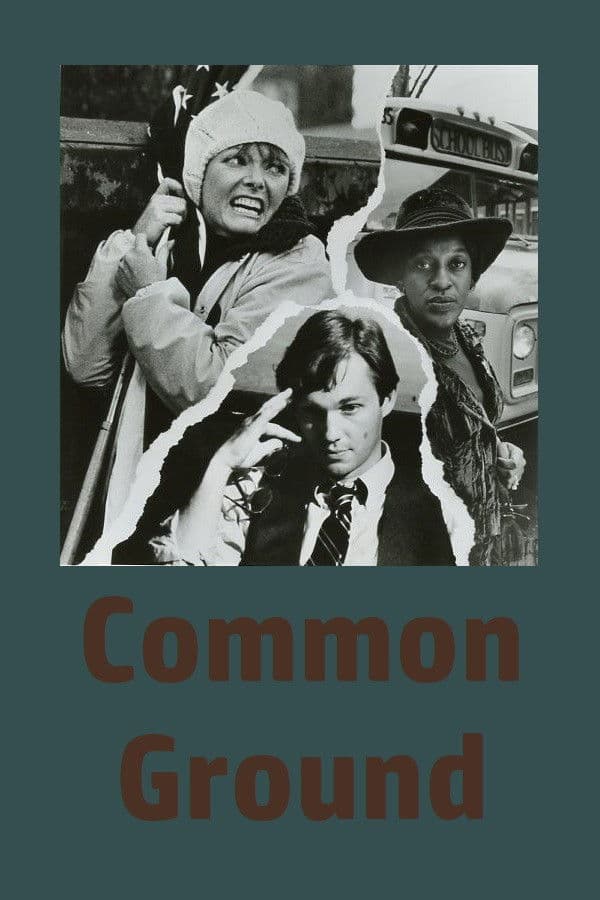
Common Ground
1990 • Drama, TV Movie
Fact based story about the racial tensions that occurred in Boston in the 1970's because of court ordered busing to end desegregation. The story focuses on an African-American mother determined to get her children a quality education and a white lawyer trying to deal with inner city problems.
Runtime: 3h 5m
Buy related books from Amazon
As an Amazon Associate I earn from qualifying purchases. Read the full disclosure.
Why you should read the novel
Before you watch the 1990 adaptation, experience the full power of Common Ground: A Turbulent Decade in the Lives of Three American Families by J. Anthony Lukas. This Pulitzer Prize–winning masterpiece takes you inside Boston’s busing crisis with unmatched depth, nuance, and context that no screen version can capture.
Lukas’s reporting follows three families over a decade, weaving personal struggle with political, legal, and cultural upheaval. You’ll gain a richer understanding of race, class, and neighborhood identity—plus the court battles, policy choices, and grassroots voices that shaped the city’s fate.
If you care about American history, social justice, and extraordinary narrative nonfiction, read the book first. Common Ground delivers layered storytelling, hard-earned insight, and comprehensive detail that make the 1990 TV movie feel like only a brief introduction.
Adaptation differences
The book’s scope is vast and meticulously reported, covering a decade of Boston’s school desegregation fight through multiple families, institutions, and neighborhoods. The 1990 adaptation necessarily condenses this sweep into a shorter runtime, narrowing events, locations, and perspectives to a streamlined narrative arc.
In print, Lukas alternates among the three profiled families while also tracing politicians, activists, judges, clergy, journalists, and school officials. The adaptation focuses on fewer characters, often compressing timelines and using composite or amalgamated figures to keep the story manageable for television pacing.
As narrative journalism, the book layers court filings, statistics, historical backstory, and extensive interviews. The screen version replaces much of that documentary context with dramatized dialogue and set-piece scenes, which can simplify motives, flatten moral ambiguities, and trim policy detail in favor of emotional beats.
Geographically and chronologically, the book maps Boston with precision—street by street, hearing by hearing, year by year—while the adaptation highlights emblematic moments and recognizable signposts. Some episodes are reordered or omitted, aftershocks receive less attention, and inner lives not directly driving the central plot are reduced, making the film more accessible but less comprehensive than Lukas’s definitive account.
Common Ground inspired from
Common Ground: A Turbulent Decade in the Lives of Three American Families
by J. Anthony Lukas