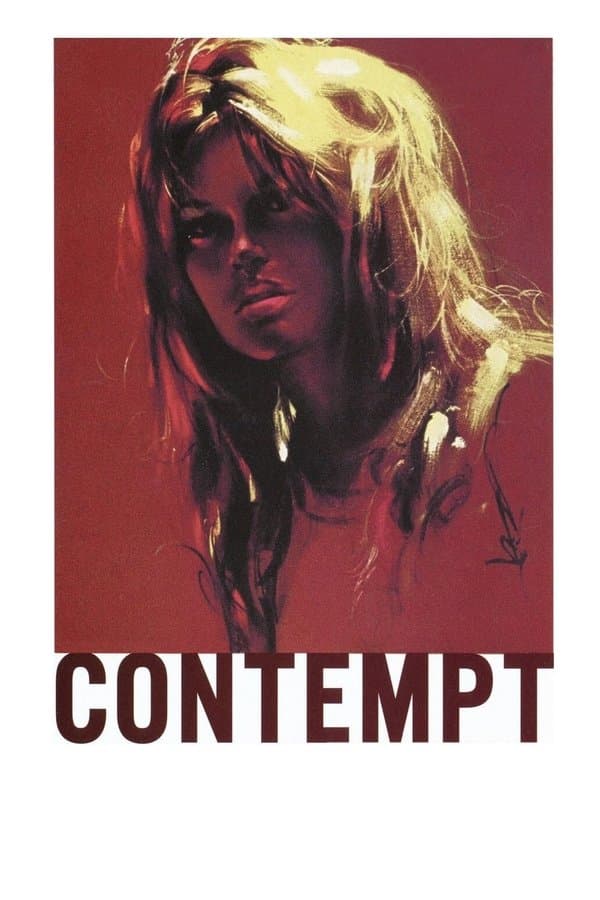
Contempt
1963 • Drama, Romance • NR
Art film producer Jeremy Prokosch, unhappy with the work of his director, hires Fritz Lang (as himself) to direct an adaptation of The Odyssey, but when it seems that the legendary filmmaker is making a picture destined to bomb, he brings in a screenwriter to energise the script. The professional intersects with the personal when a rift develops between the writer and his wife.
Runtime: 1h 43m
Buy related books from Amazon
As an Amazon Associate I earn from qualifying purchases. Read the full disclosure.
Why you should read the novels
Before pressing play on Contempt (1963), experience the source that shaped it: Alberto Moravia’s novel A Ghost at Noon, also published in English as Contempt. The book offers raw, intimate access to the couple’s unraveling that no camera can fully capture.
Moravia’s first-person voice drills into jealousy, pride, and self-deception with forensic precision, making every gesture and silence pulse with meaning. If you’re searching for Alberto Moravia Contempt book or want the definitive origin story behind the film, start with the novel.
Reading the source novel enriches the movie and stands powerfully on its own as a modern classic of Italian literature. Choose the book for deeper psychological insight, richer context, and a timeless exploration of love, ego, and betrayal that rewards close reading.
Adaptation differences
Names, roles, and emphasis shift in the adaptation. Moravia’s novel centers on screenwriter Riccardo Molteni and his wife Emilia, while Godard’s film follows Paul and Camille Javal. Producer Battista becomes Jeremy Prokosch, and the novel’s fictional director is replaced by Fritz Lang playing himself, instantly reframing the drama within real cine-history.
Point of view and tone diverge markedly. The book’s first-person narration immerses you in Riccardo’s psyche—his rationalizations, blind spots, and mounting despair. Godard opts for a cooler, more distanced style: elliptical cutting, charged silences, and color-coded compositions externalize alienation rather than verbalize it, with the apartment sequence turning emotional drift into spatial design.
The film-within-a-film functions differently. Godard foregrounds The Odyssey as a reflexive mirror of modern estrangement, using Lang’s presence and multilingual exchanges (French, English, Italian, German) to critique industry power and the meaning of images. In the novel, the production is a backdrop that sharpens the marital conflict; theoretical debates about cinema recede behind Moravia’s psychological realism.
Structure and symbolism also shift. Godard monumentalizes Capri through Casa Malaparte’s severe geometry and adds stylized moments—like the famous opening segment—that the book never seeks. Both versions trace a rupture sparked by suspicion that the husband “offers” his wife to the producer, yet the novel spells out interior motives while the film preserves ambiguity. Each ends in tragedy, but Godard frames the aftermath through myth and ongoing filmmaking, whereas Moravia closes with a moral and psychological reckoning on the page.
Contempt inspired from
Contempt
by Alberto Moravia
A Ghost at Noon
by Alberto Moravia