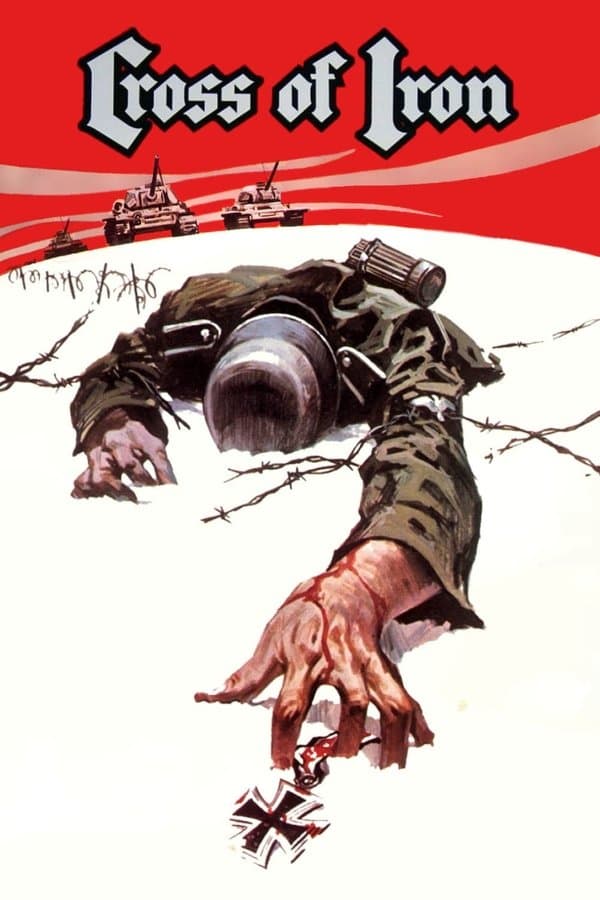
Cross of Iron
1977 • Action, Drama, History, War • R
It is 1943, and the German army—ravaged and demoralised—is hastily retreating from the Russian front. In the midst of the madness, conflict brews between the aristocratic yet ultimately pusillanimous Captain Stransky and the courageous Corporal Steiner. Stransky is the only man who believes that the Third Reich is still vastly superior to the Russian army. However, within his pompous persona lies a quivering coward who longs for the Iron Cross so that he can return to Berlin a hero. Steiner, on the other hand is cynical, defiantly non-conformist and more concerned with the safety of his own men rather than the horde of military decorations offered to him by his superiors.
Runtime: 2h 13m
Buy related books from Amazon
As an Amazon Associate I earn from qualifying purchases. Read the full disclosure.
Why you should read the novel
If you were captured by the intensity of Cross of Iron, the source novel The Willing Flesh by Willi Heinrich offers an even deeper, more immersive experience. This acclaimed World War II classic delivers raw, unfiltered frontline authenticity, psychological depth, and a richness of character you simply cannot compress into two hours of film. For readers who want the definitive Cross of Iron book experience, Heinrich’s prose is the ultimate destination.
The Willing Flesh is a landmark Eastern Front novel that thrusts you into the mud, fear, and moral gray zones that define real combat. Instead of cinematic spectacle, you get sustained tension, intimate inner monologues, and the complex bonds between soldiers under impossible pressure. If you are searching for the best World War II novel to read instead of watching the movie again, this is it.
Heinrich’s storytelling rewards readers who crave nuance: layered motivations, battlefield tactics rendered with authority, and the human cost behind every medal. The novel’s relentless honesty and psychological precision make it perfect for fans of literary war fiction, historical realism, and readers comparing Cross of Iron the movie vs the book. Start with The Willing Flesh and discover why the book endures as the essential Cross of Iron reading experience.
Adaptation differences
Scope and focus differ markedly between the book and the film. The Willing Flesh unfolds across a broader tapestry of frontline episodes and downtime behind the lines, allowing Heinrich to chart fatigue, shifting morale, and evolving relationships over time. The movie compresses events and concentrates the action within a tighter window on the Eastern Front, heightening immediacy but narrowing the saga-like breadth the novel achieves.
Characterization is more layered in the novel, especially through interior monologue. Willi Heinrich probes Steiner’s ethics, doubts, desires, and survival instincts in ways cinema can only imply, and even Stransky’s aristocratic ambition reads with greater psychological gradation on the page. By contrast, the film sharpens the Steiner–Stransky clash into a more overt class and values confrontation, turning Stransky into a clearer antagonist to drive on-screen conflict.
Tone and thematic delivery diverge as well. Heinrich’s prose sustains a grinding, existential weariness punctuated by stark sexuality and bleak camaraderie, while the film translates brutality into Peckinpah’s trademark slow-motion eruptions and montage. The movie’s bitterly ironic, abrupt ending—an audiovisual gut punch—has no direct counterpart in the novel, which resolves its conflicts within a more traditional narrative frame, even as its outlook remains uncompromisingly bleak.
Supporting perspectives and incidents are rearranged or refocused in adaptation. The film elevates staff-officer figures and set-piece battles to frame the futility of command and the absurdity of decorations, whereas the book devotes more time to the platoon’s daily grind, downtime, and the soldiers’ private coping mechanisms. Several subplots and sexual frankness that enrich the novel’s texture are streamlined or toned down on screen, making the movie more concentrated but the book more expansive, intimate, and thematically layered.
Cross of Iron inspired from
The Willing Flesh (also published as Cross of Iron)
by Willi Heinrich