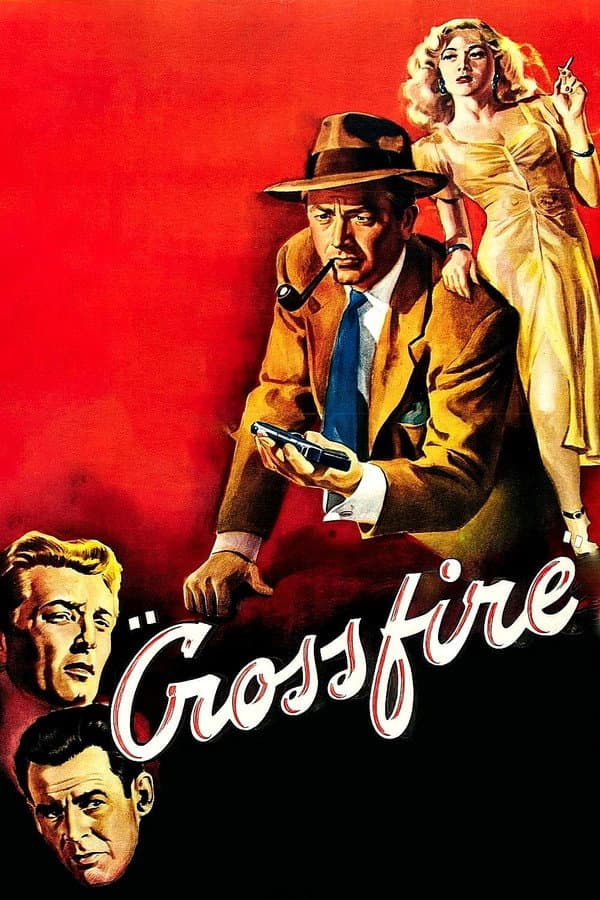
Crossfire
1947 • Crime, Mystery, Thriller • NR
A man is murdered, apparently by one of a group of soldiers just out of the army. But which one? And why?
Runtime: 1h 26m
Buy related books from Amazon
As an Amazon Associate I earn from qualifying purchases. Read the full disclosure.
Why you should read the novel
Before you watch Crossfire (1947), experience the unfiltered power of its source: The Brick Foxhole by Richard Brooks. This gripping World War II–era crime novel delivers raw tension, razor-sharp dialogue, and a fearless dive into prejudice and violence that studios of the time couldn’t fully portray.
Reading The Brick Foxhole gives you the original themes intact—Brooks confronts homophobia head-on, exploring group dynamics among servicemen, moral complicity, and the psychological scars of war. The novel’s immediacy, interior nuance, and gritty realism make it essential noir fiction for readers who crave depth beyond the screen.
If you’re searching for the Crossfire book, the source novel, or the best noir to read next, pick up The Brick Foxhole by Richard Brooks in paperback, ebook, or audiobook. Compare book vs. movie, discover what the film left out, and unlock the story as it was meant to be read.
Adaptation differences
The most important difference between Crossfire (1947) and The Brick Foxhole is thematic: the novel centers on a murder driven by homophobia, while the film—constrained by the Hays Code—reframes the crime as an act of antisemitism. This shift preserves the story’s anti-bigotry message but redirects its focus, changing the identity of the victim and the social critique at the heart of the narrative.
Character emphasis and structure also diverge. The film foregrounds Detective Finlay’s investigation and pairs it with Sgt. Keeley’s efforts, delivering a sleek procedural with flashbacks and declarative speeches. The book keeps readers closer to the veterans’ world and psychology, unfolding through tougher, more intimate perspectives that emphasize barracks culture, peer pressure, and the volatile aftermath of wartime service.
Tone and content are notably different. Brooks’s novel is frank about sexuality, violence, and the corrosive effects of prejudice, while the movie softens language and implication to meet studio-era standards. Crossfire adds didactic moments to guide audience interpretation; The Brick Foxhole is bleaker, more confrontational, and less inclined to reassure, giving the material a harsher moral texture.
Details, names, and relationships are streamlined for the screen. The film compresses timelines, reduces suspects, and reshapes backstories to maintain pace and clarity, including a more overt public-service message against bigotry. The book lingers on group dynamics, paranoia, and the casual cruelties of off-duty life, offering a denser portrait of motives and complicity than the adaptation can accommodate.
Crossfire inspired from
The Brick Foxhole
by Richard Brooks