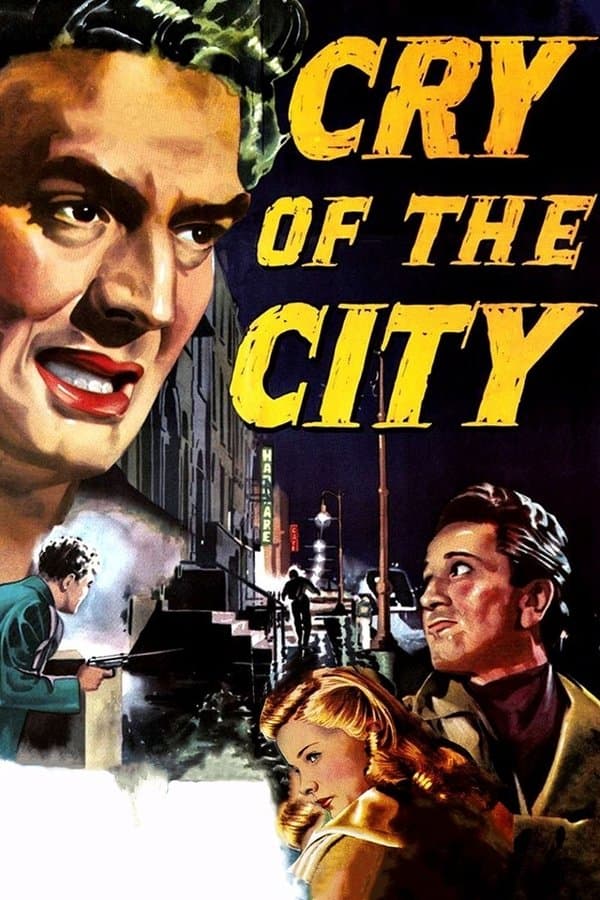
Cry of the City
1948 • Crime, Drama • NR
Petty crook and cop-killer Martin Rome, in bad shape from wounds in the hospital prison ward, still refuses to help slimy lawyer Niles clear his client by confessing to another crime. Police Lt. Candella must check Niles' allegation; a friend of the Rome family, he walks a tightrope between sentiment and cynicism. When Martin fears Candella will implicate his girlfriend Teena, he'll do anything to protect her. How many others will he drag down to disaster with him?
Runtime: 1h 35m
Buy related books from Amazon
As an Amazon Associate I earn from qualifying purchases. Read the full disclosure.
Why you should read the novel
Before you stream Cry of the City, consider reading The Chair for Martin Rome by Henry Edward Helseth. The novel delivers a deeper, more intimate dive into Martin Rome’s troubled psyche and the urban tensions of postwar New York—layers the film can only suggest.
Helseth’s prose captures the city’s breath: tenement stairwells, late‑night storefronts, and the uneasy hush of hospital corridors. If you love crime fiction that lives and breathes its setting, the book’s atmospheric detail and authentic street rhythms make every page feel dangerous and alive.
For fans of classic noir, reading the source novel offers the complete experience—richer motivations, sharper moral dilemmas, and a slow-burn intensity that rewards close attention. Discover why The Chair for Martin Rome stands as a crime fiction classic worth reading instead of watching the movie alone.
Adaptation differences
One major difference between Cry of the City and the book is perspective and depth of character. The Chair for Martin Rome spends far more time inside Martin’s head—his fears, rationalizations, and memories—giving readers a psychological map the film can only sketch through glances and dialogue.
The novel’s plotting is broader and more layered. Subplots are expanded, minor players get fuller arcs, and several incidents are more intricately connected. The film streamlines the investigation, compresses timelines, and likely combines or trims characters to maintain pace and clarity for a feature-length runtime.
Tone and content shift under the Production Code. On screen, violence, corruption, and sexuality are softened or implied, while the moral throughline is clarified. In the book, consequences feel murkier and more psychologically fraught, allowing shades of gray that the movie reduces to sharper contrasts between order and lawbreaking.
Setting texture also differs. Helseth’s novel lingers on neighborhood ties, immigrant identities, and the pull of community loyalty in ways the adaptation condenses. If you’re comparing the Cry of the City movie vs. the book, expect the novel’s New York—its dialects, customs, and street-level detail—to be richer, the themes of identity and loyalty more nuanced, and the finale more morally tangled than the film’s cleaner sense of retribution.
Cry of the City inspired from
The Chair for Martin Rome
by Henry Edward Helseth