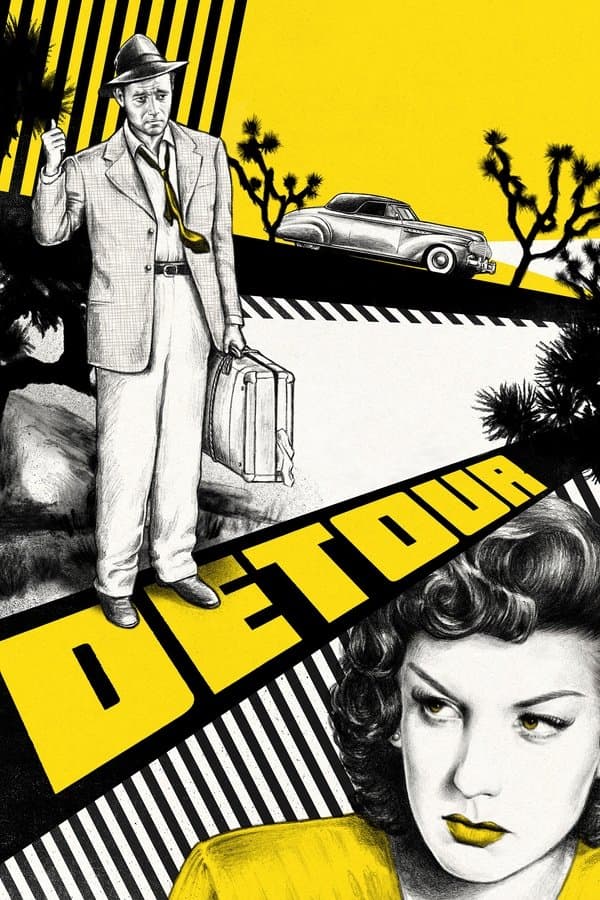
Detour
1945 • Drama, Thriller • NR
The life of Al Roberts, a pianist in a New York nightclub, turns into a nightmare when he decides to hitchhike to Los Angeles to visit his girlfriend.
Runtime: 1h 8m
Buy related books from Amazon
As an Amazon Associate I earn from qualifying purchases. Read the full disclosure.
Why you should read the novel
Before you rewatch Detour (1945), experience the raw pulse of Martin M. Goldsmith’s novel Detour—the hardboiled original that inspired the legendary film noir. The book delivers a darker, sharper plunge into fate and desperation.
On the page, Goldsmith’s lean prose and relentless first-person voice pull you inside the drifter’s head, exposing motives, rationalizations, and fears the movie can only hint at. The result is a grimmer, more intimate noir journey.
If you crave the full story behind the cult classic, read the source. Discover the unfiltered tension, moral ambiguity, and razor-edged psychology that made Detour a cornerstone of American crime fiction.
Adaptation differences
Names and point of view shift notably. In the novel, the protagonist is Alexander Roth; the film renames him Al Roberts. Both versions use a confessional voice, but the book’s first-person narration sustains deeper, uninterrupted interior monologue than the movie’s voiceover can deliver.
Violence and culpability are tougher in print. Goldsmith’s novel renders the deadly turns with far less ambiguity, while the 1945 film reframes key deaths as accidents—choices shaped by Production Code demands that discouraged showing a protagonist commit and evade clear-cut murder.
Scope and detail compress on screen. The book lingers on the cross-country grind, artistic frustrations, and the corrosive psychology of chance encounters; the film, shot on a shoestring, trims episodes, simplifies backstory (including the girlfriend’s presence), and confines action to a handful of sets to maintain ruthless momentum.
Endings and tone diverge. The film underscores cosmic punishment with a stark police pickup and fatalistic narration. The novel’s conclusion leans more heavily on moral ambiguity and the narrator’s self-incrimination, leaving a harsher aftertaste that deepens the story’s bleak, noir worldview.
Detour inspired from
Detour
by Martin M. Goldsmith