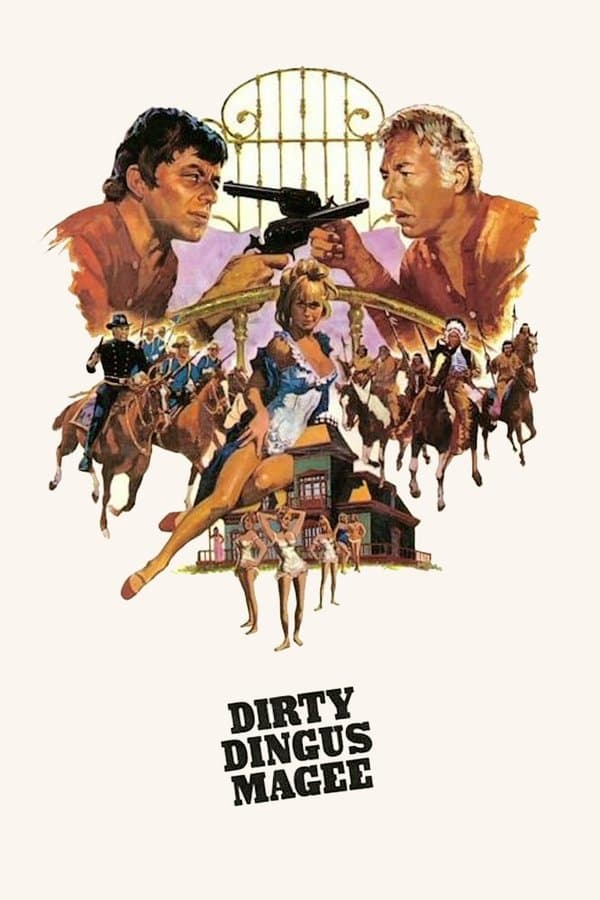
Dirty Dingus Magee
1970 • Comedy, Western • PG-13
Ass-breaker Dingus Magee is looking for a gold train when he comes upon old acquaintance Hoke Birdsill on stage to San Francisco, and robs him of his money. Hoke goes to the nearby town of Yerkey's Hole, where Belle Knops is both mayor and bordello-mistress. She appoints Hoke Town Sheriff and tries to get him to stir up the Indians so the soldiers at the nearby fort (the main customers) won't go to Little Big Horn. Dingus tries to stir up more trouble and get involved with the pale, baby-talking Indian, Anna. The film is a send-up of the oft-repeated phrase "the Code of the West" and exaggerates it and what it stands for into the ridiculousness that it is.
Runtime: 1h 31m
Buy related books from Amazon
As an Amazon Associate I earn from qualifying purchases. Read the full disclosure.
Why you should read the novel
Before you watch Dirty Dingus Magee (1970), read David Markson’s The Ballad of Dingus Magee. The novel delivers razor-sharp Western satire, verbal wit, and a raucous tall-tale voice the screen can’t match.
Markson’s prose turns every con, shootout, and seduction into a clever deconstruction of frontier mythmaking. Fans of literary Westerns will love the layered humor, vivid side characters, and sly narrative asides that reward careful reading.
Searching for the definitive Dirty Dingus Magee experience? The original book offers deeper world-building, richer character nuance, and more audacious comedy—making it the essential choice over a quick movie viewing.
Adaptation differences
The biggest difference between the Dirty Dingus Magee movie and the book is tone. David Markson’s novel wields biting, bawdy satire and sharper edges, while the film leans into broad slapstick and softens the bite for a more easygoing romp.
The book’s mock-epic voice and playful, self-aware narration are central to its charm. On screen, that distinctive storytelling is replaced by straightforward gags and visual bits, losing the novel’s linguistic fireworks, authorial asides, and meta-humor.
Structurally, the novel unfolds as an episodic picaresque stuffed with eccentric encounters and running jokes. The adaptation compresses, rearranges, and merges material into a simpler storyline, inventing or streamlining characters and set pieces to service quick laughs and tidy momentum.
Thematically, Markson’s book skewers American mythmaking—opportunism, lust, violence, and tall-tale exaggeration—while keeping its antihero morally slippery. The film reframes the chaos as a lighthearted caper, emphasizing affable roguishness over ambiguity and resolving conflicts with punchlines rather than the novel’s barbed irony.
Dirty Dingus Magee inspired from
The Ballad of Dingus Magee
by David Markson