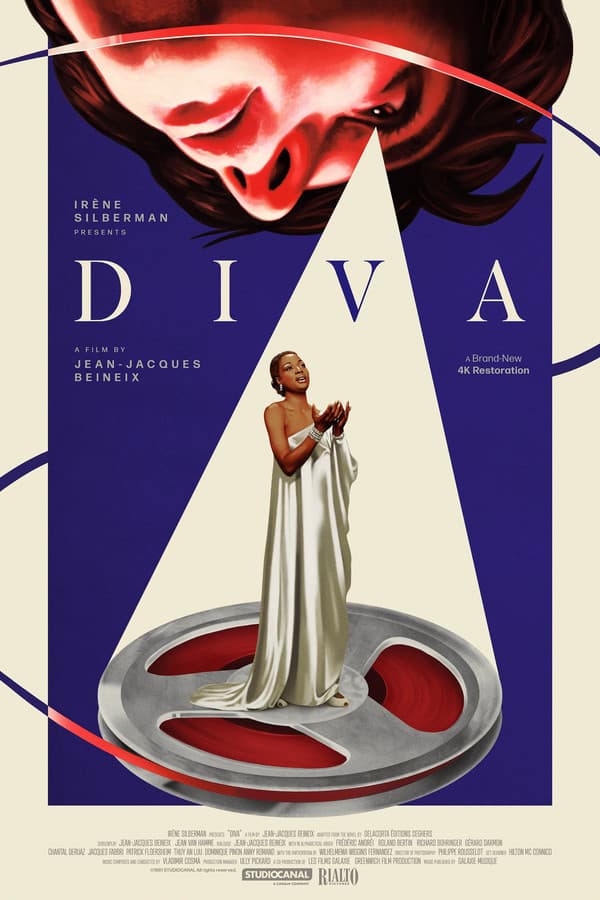
Diva
1981 • Action, Drama, Thriller • R
Jules, a young Parisian postman, secretly records a concert performance given by the opera singer Cynthia Hawkins, whom he idolises. The following day, Jules runs into a woman who is being pursued by armed thugs. Before she is killed, the woman slips an audio cassette into his mail bag...
Runtime: 1h 57m
Buy related books from Amazon
As an Amazon Associate I earn from qualifying purchases. Read the full disclosure.
Why you should read the novel
Before you cue up Diva (1981), discover the electric pulse of its source: Delacorta’s novel Diva in English. The book delivers the lean, sultry crime tale that inspired Jean-Jacques Beineix’s cult classic, with Jules, Cynthia Hawkins, Gorodish, and Alba drawn in razor-sharp lines.
Reading the original novel gives you what the screen can’t: intimate motivations, sly interior monologue, and the noir humor threading through Paris’s criminal underbelly. If you’re searching for “Diva book vs movie,” the prose offers richer context, darker wit, and a street-level texture the film only hints at.
Choose the book to experience the suspense at your own pace, linger over Delacorta’s crystalline scenes, and savor the mythic aura of the opera diva from the inside out. For fans of French noir, stylish thrillers, and source material purists, reading Diva is the most rewarding way to absorb this story.
Adaptation differences
Tone and emphasis shift significantly between Delacorta’s Diva and the 1981 film. The novel leans harder into laconic noir cool, sardonic humor, and psychological tension, while the adaptation foregrounds visual style—neon sheen, color-drenched frames, and operatic set pieces—turning atmosphere into the dominant storytelling engine.
Characterization deepens on the page. Jules’s infatuation, ethical lines, and risk calculus read more nuanced in prose; Cynthia Hawkins’s aura folds in professional pressures and artistic principles; and the iconic duo Gorodish and Alba reveal more philosophy, playfulness, and paradox. On screen, they’re magnetically enigmatic, but the novel supplies added layers and backstory that clarify their choices.
Plot architecture is tighter and more interior in the book, whereas the film streamlines threads and heightens spectacle. The movie adds or greatly embellishes kinetic moments—most famously the Paris Métro moped pursuit—compressing timelines and consolidating antagonists to keep momentum high. The novel’s cat-and-mouse rhythms breathe more, with investigative beats and street-level detail that build a slower-burn suspense.
Themes resolve differently in feel. On the page, moral ambiguity and the costs of obsession sit closer to the surface, and ambiguity lingers after key confrontations. The film aims for a sleeker, cleaner payoff and lets music do immediate emotional lifting; the book must evoke arias in language, shifting the focus toward perception, memory, and desire. For “Diva book vs movie” seekers, expect the novel to be moodier and more intimate, and the film to be bolder and more operatic.
Diva inspired from
Diva
by Delacorta