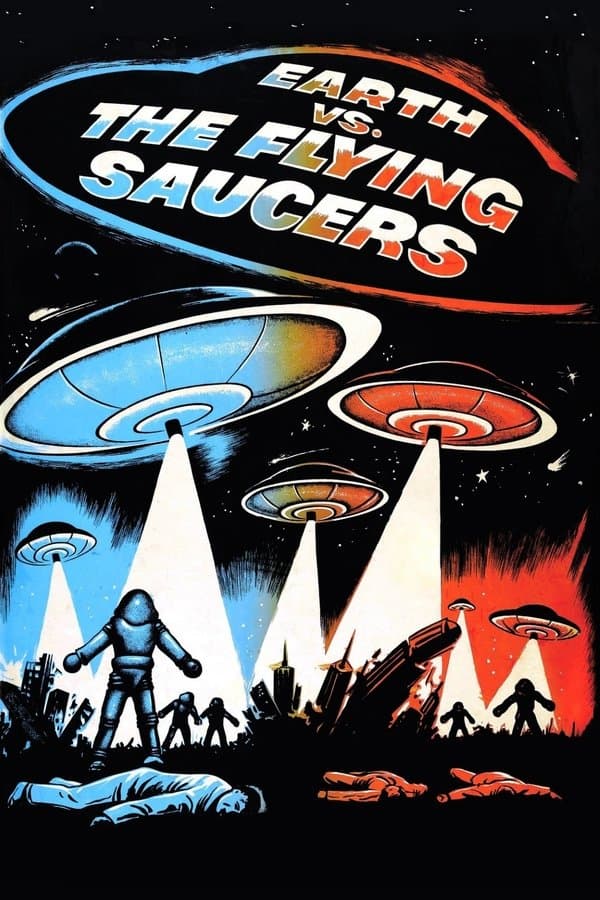
Earth vs. the Flying Saucers
1956 • Action, Science Fiction • NR
Test space rockets exploding at liftoff and increased reporting of UFO sightings culminate in a direct attempt by alien survivors of a dead, extra-galactic civilization to invade Earth from impervious flying saucers, using ray-weapons of mass destruction.
Runtime: 1h 23m
Buy related books from Amazon
As an Amazon Associate I earn from qualifying purchases. Read the full disclosure.
Why you should read the novels
Before you cue up Earth vs. the Flying Saucers (1956), discover Donald E. Keyhoe’s original investigations in Flying Saucers from Outer Space and The Flying Saucers Are Real. These landmark UFO books combine pilot testimony, radar cases, and government memos, offering the context the movie can only hint at.
Reading the source books gives you a front-row seat to early Cold War UFO research, Project Sign/Grudge/Blue Book controversies, and the media storm that shaped public perception. Keyhoe’s clear, journalistic prose lets you weigh evidence, contradictions, and patterns for yourself.
If you’re searching for credible UFO books in English, start here. Explore primary-source interviews, declassified leads, and skeptical analysis that turn a sensational invasion into a nuanced, fact-driven mystery—perfect for readers who prefer documented cases over special-effects spectacle.
Adaptation differences
Earth vs. the Flying Saucers is a fictional invasion thriller, while Donald E. Keyhoe’s books are nonfiction investigations. The movie invents protagonists (Dr. Russell A. Marvin and Carol), a marriage subplot, and a linear attack narrative to supply cinematic stakes and momentum absent from the source material.
Spectacle replaces documentation. The film showcases hostile aliens, city-destroying energy beams, and Ray Harryhausen’s iconic saucer crashes through landmarks. Keyhoe’s books present no set-piece battles or collapsing monuments; instead they compile eyewitness reports, pilot encounters, and references to official studies without definitive proof of recovered craft.
Communication and technology shift dramatically. The movie introduces a translation device, mind-control interrogation, abductions of scientists, and reverse-engineered ultrasonic weapons that decisively counter the invaders. In the books, contact remains ambiguous; technology is inferred from sightings and radar returns, and conclusions are cautious rather than conclusive.
Tone and resolution diverge. The adaptation delivers clear villains, a final battle, and closure as humanity triumphs. Keyhoe’s narratives end with uncertainty and a call for government transparency, emphasizing surveillance, secrecy, and unresolved evidence over open warfare—core differences that define the book-to-film adaptation.
Earth vs. the Flying Saucers inspired from
Flying Saucers from Outer Space
by Donald E. Keyhoe
The Flying Saucers Are Real
by Donald E. Keyhoe