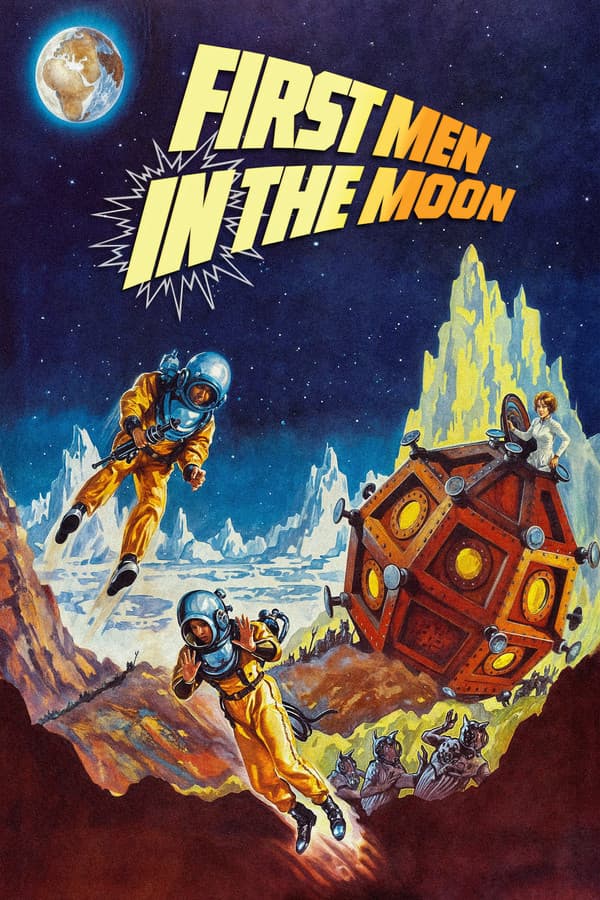
First Men in the Moon
1964 • Adventure, Science Fiction • NR
The world is delighted when a spacecraft containing a crew made up of the world's astronauts lands on the moon, but are shocked when the astronauts discover an old British flag and a document declaring that the moon is taken for Queen Victoria proving that the astronauts were not the first men on the moon.
Runtime: 1h 43m
Buy related books from Amazon
As an Amazon Associate I earn from qualifying purchases. Read the full disclosure.
Why you should read the novel
Before you watch the 1964 film First Men in the Moon, read The First Men in the Moon by H. G. Wells, the classic science fiction novel that launched this lunar adventure. Wells’s original book offers visionary ideas, vivid worldbuilding, and the pioneering concept of Cavorite, all delivered with the author’s sharp wit and sense of wonder.
On the page, Arnold Bedford’s first-person voice pulls you into a story rich with social satire, ethical dilemmas, and speculative science. The Grand Lunar scenes and the intricate Selenite society are far more nuanced in the novel, rewarding readers who want deeper themes beyond special effects.
If you love classic sci-fi, steampunk-adjacent adventures, and thought-provoking Victorian literature, The First Men in the Moon by H. G. Wells is a must-read. Find authoritative English editions in print, ebook, and audiobook, and experience the original vision that inspired the movie. Choose the book over the film for depth, detail, and timeless imagination.
Adaptation differences
Structure and framing: The 1964 adaptation opens with a modern United Nations Moon landing that discovers a Victorian flag and a note, then flashes back to Bedford’s tale. The novel instead unfolds as Bedford’s memoir without a contemporary space-race frame, creating a more intimate, reflective narrative.
Characters and relationships: The film adds Kate as a significant companion and romantic interest, a character absent from the book. It also softens Bedford, who in the novel is more morally ambiguous and financially driven, while emphasizing Cavor’s eccentric humor much more than Wells’s text.
Tone and themes: H. G. Wells’s novel leans into social critique, economics, imperialism, and the ethics of scientific discovery, particularly through extended dialogue with the Grand Lunar. The movie prioritizes spectacle, humor, and Ray Harryhausen creature set pieces, trimming the philosophical discussions that define the book.
Selenites and ending: The book presents a complex, specialized Selenite society, with Cavor’s radio messages ending in ominous silence after hinting they may try to contain humanity. The film portrays more hostile warriors and a mooncalf, and ultimately suggests the lunar civilization is wiped out by human germs introduced by the visitors, a reversal of The War of the Worlds trope.
First Men in the Moon inspired from
The First Men in the Moon
by H. G. Wells