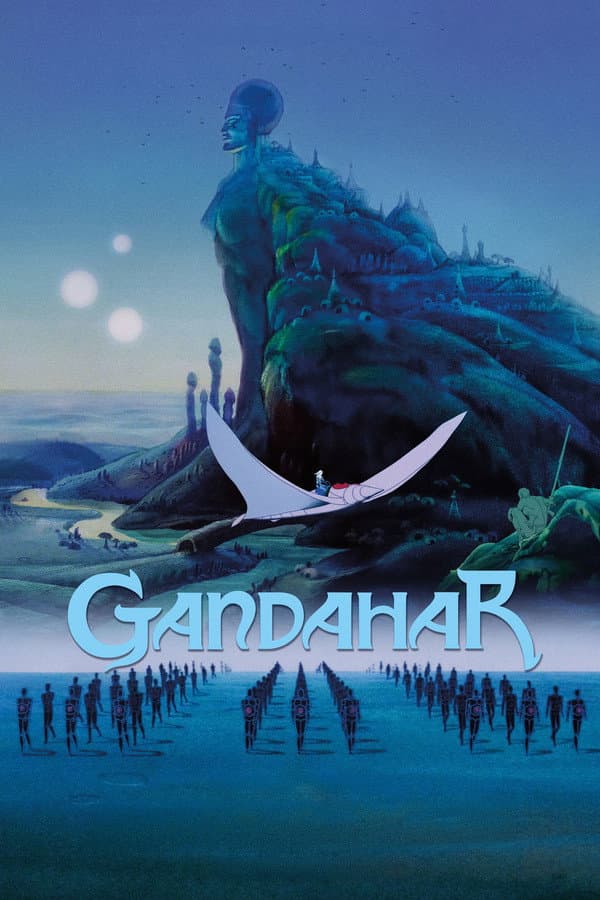
Gandahar
1987 • Adventure, Animation, Fantasy, Science Fiction
On the planet Gandahar where peace reigns and poverty is unknown, this utopian lifestyle is upset by reports of people at the outlying frontiers being turned to stone. Sylvain is sent to investigate this mysterious threat.
Runtime: 1h 23m
Buy related books from Amazon
As an Amazon Associate I earn from qualifying purchases. Read the full disclosure.
Why you should read the novel
If the visionary animation of Gandahar (1987) captivated you, read the source novel The Machine-Men Against Gandahar by Jean-Pierre Andrevon. The book expands the science-fantasy world with layered politics, ecology, and time-bending ideas the film can only suggest. Experience the original context, voice, and themes that shaped the movie’s most haunting images.
Reading the Gandahar book delivers deeper character motivations and richer world-building. Andrevon’s prose lingers on cultures, languages, and bio-organic technologies, turning striking visuals into fully realized societies and ethical dilemmas. For fans of classic French science fiction and philosophical adventures, this novel is a must-read.
Choose the book instead of the movie to discover unfiltered social critique, nuanced history, and a more complex treatment of time and consequence. Seek out Jean-Pierre Andrevon’s Gandahar novel in English under The Machine-Men Against Gandahar, or explore the original French if you can, for the definitive Gandahar experience.
Adaptation differences
Book vs movie world-building: the novel elaborates Gandahar’s provinces, governance, and cultural traditions, while the film compresses this scope into a handful of dreamlike set pieces. On the page, landscapes, fauna, and technologies are explained and contextualized; on screen they are largely symbolic and impressionistic.
Thematic emphasis differs: Andrevon foregrounds environmental stewardship, anti-militarism, and social critique with sharper detail, whereas the René Laloux adaptation abstracts these concerns into a more universal, lyrical allegory. The movie’s tone is meditative and pacifist; the book’s voice is more pointed, with political texture and moral ambiguity.
Narrative structure and characters are streamlined in the film. The novel develops multiple factions, conflicting agendas, and the evolving logic of the Machine-Men with greater granularity. The movie focuses on a single investigative throughline, simplifies the time-loop mechanics, and merges or omits side characters to fit its concise runtime.
Endings and stakes diverge in emphasis. The book traces the aftermath—civic consequences, ecological rebuilding, and the ethical cost of victory—while the film concludes with a poetic, enigmatic coda. In the movie, cyclical time and visual metaphor dominate; in the novel, causes and effects are interrogated to highlight responsibility and long-term change.
Gandahar inspired from
The Machine-Men Against Gandahar
by Jean-Pierre Andrevon