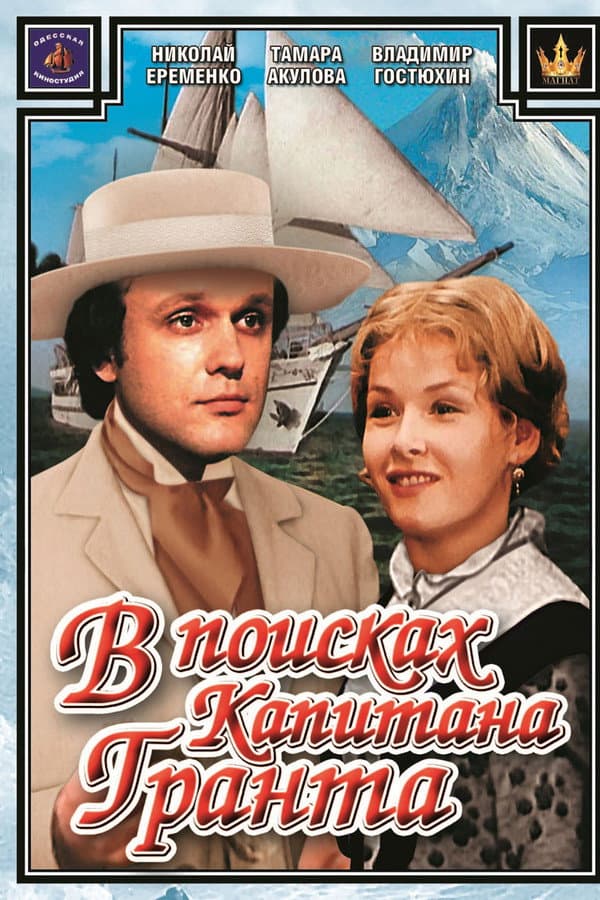
In Search for Captain Grant
1985 • Adventure
Lord and Lady Glenarvan found a bottle in the ocean. this bottle contained a letter from captain Grant that he and 2 of his sailors had survived a disaster in sea and need help. Unfortunately, the letter was damaged by water, and only latitude is known (37 degrees), but no longitude. The Glenarvans decide to find captain Grant.
Runtime: 7h 35m
Buy related books from Amazon
As an Amazon Associate I earn from qualifying purchases. Read the full disclosure.
Why you should read the novel
Before you watch the 1985 adaptation of In Search for Captain Grant, discover Jules Verne’s original novel In Search of the Castaways (also known as Captain Grant’s Children). The book delivers Verne’s trademark sense of wonder: real geography, ingenious clues, bold voyages along the 37th parallel, and a cast of unforgettable companions whose wit and courage shine on the page.
Reading the source novel unlocks layers that no screen version can fully capture. Verne’s rich scientific curiosity, playful linguistic puzzles, and detailed cultural and natural-history observations deepen every stop in South America, Australia, and New Zealand. You’ll experience the suspense of decoding the bottle’s message and the evolving relationships among Lord Glenarvan, Lady Helena, Paganel, the Grants, Major McNabbs, and John Mangles with far greater nuance.
If you love classic adventure, choose the unabridged book for its expansive worldbuilding, humor, and heart. Modern English translations make Verne’s prose vivid and accessible, letting you savor the original pacing, the full arc of Ayrton’s story, and the thematic breadth that inspired generations—long before any film adaptation set sail.
Adaptation differences
The 1985 miniseries is a largely faithful retelling, but like most adaptations, it compresses Verne’s expansive travelogue. To fit the screen, the journey’s timeline is tightened, several secondary encounters are merged or omitted, and transitions between South America, Australia, and New Zealand are streamlined. The bottle’s clue still drives the plot, yet the step-by-step, text-based sleuthing is abbreviated compared with the novel’s chapter-by-chapter unraveling.
Character focus also shifts. The screen version tends to foreground the central quartet—Lord Glenarvan, Lady Helena, Mary Grant, and John Mangles—while giving less space to the dry wit of Major McNabbs and the full range of Paganel’s scholarly asides. Romance between Mary and John is typically brought forward and simplified, and Ayrton’s backstory and moral complexity are condensed, making his transformation more abrupt than in the book’s carefully staged redemption arc.
Verne’s hallmark digressions—natural history, ethnography, navigation, and multilingual wordplay—are trimmed for pacing. The multilingual ambiguities in the damaged note that fuel Paganel’s hilarious misreadings are simplified on screen, and some episodic detours (and minor local characters) disappear. The result is a brisk adventure that privileges movement and spectacle over the novel’s slow-burn clue analysis and educational texture.
Tone and themes are subtly adjusted. The adaptation generally opts for family-friendly peril, softening some of the book’s harsher survival challenges and reframing or omitting 19th-century colonial-era stereotypes. Visual storytelling replaces Verne’s lengthy descriptive passages, which enhances immediacy but narrows the thematic breadth. In short, the 1985 screen version captures the spirit of the quest, while the novel offers the deeper puzzle-solving, scientific curiosity, and character nuance that made Jules Verne a timeless classic.
In Search for Captain Grant inspired from
In Search of the Castaways (a.k.a. Captain Grant's Children)
by Jules Verne