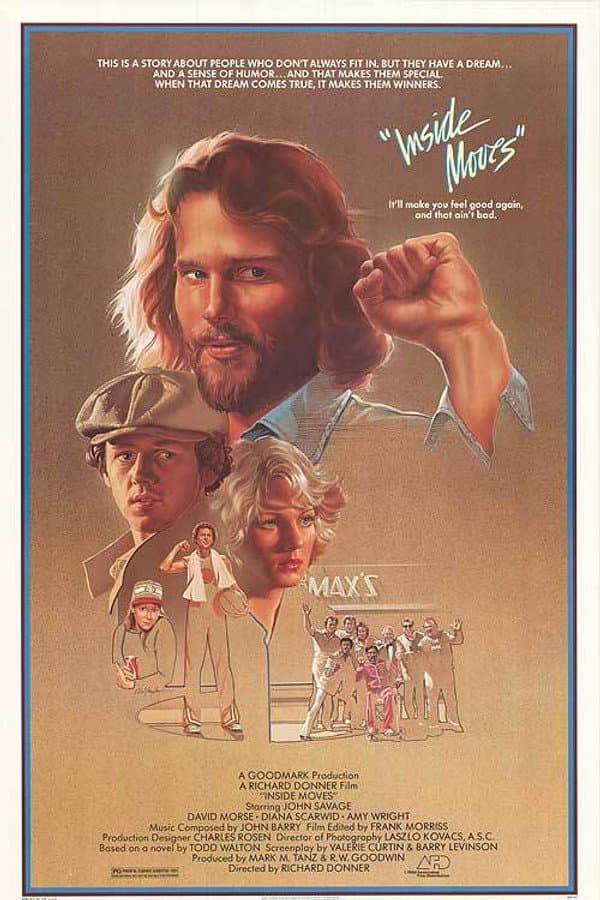
Inside Moves
1980 • Drama • PG
After a failed suicide attempt leaves him partially crippled, Rory begins spending a lot of time at a neighborhood bar full of interesting misfits. When Jerry the bartender suddenly finds himself playing basketball for the Golden State Warriors, Rory and the rest of the bar regulars hope his success will provide a lift to their sagging spirits. Will Jerry forget his friends? What about his junkie hooker girlfriend and her pimp?
Runtime: 1h 53m
Buy related books from Amazon
As an Amazon Associate I earn from qualifying purchases. Read the full disclosure.
Why you should read the novel
Experience the deepest heart of Inside Moves in Todd Walton’s original novel, where the voice is intimate, the humor is wry, and the compassion is unflinching. The book invites you into a richly observed neighborhood bar, revealing the inner lives of people society often overlooks—rendered with empathy, lyricism, and emotional precision that only prose can deliver.
Choose the Inside Moves novel over the movie to savor layered backstories, patient character development, and the subtleties of friendship, recovery, and dignity. Walton’s pages linger on the quiet beats between the big moments, offering insight into trauma, hope, and community that unfolds with literary depth and resonance.
If you’re seeking powerful, character-driven storytelling, the Inside Moves book by Todd Walton gives you the author’s full, original vision. It’s ideal for readers who love intimate fiction, for book clubs exploring resilience and belonging, and for anyone who prefers to read the source before watching an adaptation.
Adaptation differences
While the film tells the story with visual economy, the Inside Moves novel leans into interiority—thoughts, memories, and private reckonings that shape the characters’ choices. The book’s close narrative perspective (often confessional in tone) slows down pivotal moments, adding layers of motivation and ambiguity that the screen, by necessity, condenses or externalizes.
Character focus broadens in the novel, which spends more time with the bar’s regulars, giving them distinct histories and emotional arcs. The movie streamlines this community—merging or reducing roles—to keep the plot moving, and places greater emphasis on a central relationship and conflicts that play faster in a two-hour runtime.
The film heightens the sports-driven momentum for accessibility and pacing, framing the athletic comeback as a key engine of hope and tension. In the book, that thread is vital but more thematically balanced with friendship, responsibility, and the ethics of loyalty; disability and healing are treated with quieter, more nuanced gradations than the movie’s inspirational beats typically allow.
Tonal resolution also shifts. The novel’s ending feels more bittersweet and contemplative, allowing unresolved emotions to echo, whereas the adaptation favors a cleaner, more cathartic close. Details of chronology and event sequencing are tightened on-screen, altering emphasis and character dynamics; reading the novel reframes familiar scenes with added context, moral complexity, and reflective grace.
Inside Moves inspired from
Inside Moves
by Todd Walton