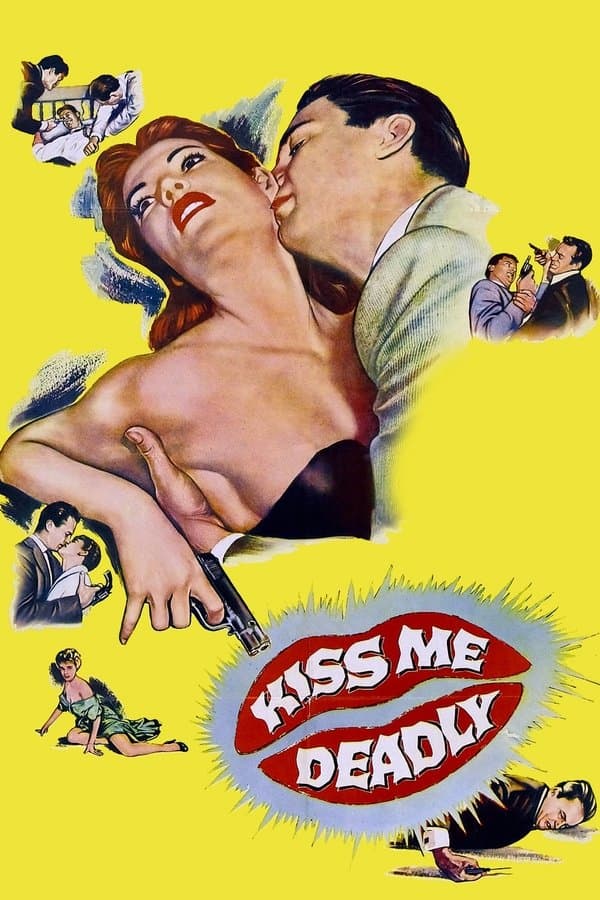
Kiss Me Deadly
1955 • Crime, Mystery, Thriller
One evening, Hammer gives a ride to Christina, an attractive hitchhiker on a lonely country road, who has escaped from the nearby lunatic asylum. Thugs waylay them and force his car to crash. When Hammer returns to semi-consciousness, he hears Christina being tortured until she dies. Hammer, both for vengeance and in hopes that "something big" is behind it all, decides to pursue the case.
Runtime: 1h 46m
Buy related books from Amazon
As an Amazon Associate I earn from qualifying purchases. Read the full disclosure.
Why you should read the novel
Before you press play, meet Mike Hammer where he was born: on the page. Mickey Spillane’s Kiss Me, Deadly novel delivers raw, high-voltage noir with razor-edged dialogue, relentless pacing, and a New York underworld only print can fully conjure.
Reading Kiss Me, Deadly lets you inhabit Hammer’s head—his code, his rage, his bleak humor—in ways the movie can only hint at. Spillane’s hardboiled prose turns every alley, bar, and backroom into a charged battleground, making the mystery more immersive, personal, and shockingly immediate.
If you love classic crime fiction, get the source that launched the legend. The original Mickey Spillane book offers deeper character stakes, tougher moral choices, and a grittier payoff—perfect for fans of Mike Hammer, hardboiled P.I.s, and mid-century noir literature.
Adaptation differences
The film reimagines the central mystery. In Mickey Spillane’s novel, the case coils around organized crime and narcotics, a grounded, street-level menace. The movie swaps that for a mysterious, dangerously radioactive “whatsit,” tilting the story toward atomic-age paranoia and apocalyptic symbolism.
Setting shifts reshape the mood. Spillane’s book prowls a grim, claustrophobic New York City—Hammer’s natural hunting ground. The adaptation moves the action to Los Angeles, trading vertical shadows and urban choke-points for sun-blasted boulevards and canyons, altering the city-as-character dynamic and the texture of every pursuit.
Tone and characterization diverge sharply. On the page, Hammer is a brutal, take-no-prisoners avenger whose ruthless methods are framed as part of his personal code. The film paints him as more venal and morally compromised, using his divorce shakedowns and opportunism to critique rather than celebrate vigilantism, shifting the story’s politics and emotional center.
Key plot beats and players are reworked. The opening encounter with the doomed woman is staged differently, the police ally becomes Lt. Pat Murphy on screen (versus Captain Pat Chambers in the book), and several supporting roles are merged or repurposed. Most strikingly, the movie’s beach-house inferno—triggered by the radioactive MacGuffin—has no counterpart in the novel’s more conventional, mob-focused showdown.
Kiss Me Deadly inspired from
Kiss Me, Deadly
by Mickey Spillane