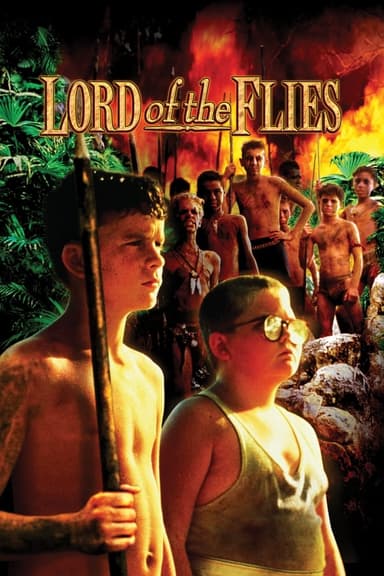
Lord of the Flies
1963 • Adventure, Drama, Thriller • PG-13
Following a plane crash a group of schoolboys find themselves on a deserted island. They appoint a leader and attempt to create an organized society for the sake of their survival. Democracy and order soon begin to crumble when a breakaway faction regresses to savagery with horrifying consequences.
Runtime: 1h 32m
Buy related books from Amazon
As an Amazon Associate I earn from qualifying purchases. Read the full disclosure.
Why you should read the novel
Before pressing play on the 1963 film, consider reading William Golding’s Lord of the Flies book—the original, unsettling masterpiece. The novel’s precise prose, layered symbolism, and haunting psychology offer a depth the camera can’t fully capture, making it essential classic literature for students, book clubs, and thoughtful readers.
Golding’s novel explores civilization versus savagery, leadership, morality, and fear with unmatched nuance. From the conch and signal fire to the enigmatic “beast” and the pig’s head, the book’s motifs invite close reading, annotation, and discussion—ideal for anyone seeking the definitive Lord of the Flies experience.
Available in modern paperback, hardcover, and ebook editions, Lord of the Flies is easy to find and rewarding to revisit. Read the source material to understand the themes, character arcs, and symbolic vision that shaped the cultural impact of every adaptation that followed.
Adaptation differences
The 1963 adaptation captures the plot and mood but necessarily trims the novel’s interiority. On the page, readers access Ralph’s, Piggy’s, and Jack’s thoughts, moral hesitations, and shifting power dynamics; on screen, much of this becomes visual suggestion, gesture, and silence, changing how motives and themes register.
The novel’s eerie “Lord of the Flies” encounter gives Simon an extended, hallucinatory dialogue that clarifies the story’s allegory. In the film, his confrontation with the pig’s head leans on images and sound design rather than sustained inner conversation, making the meaning more implicit and open to viewer interpretation.
Moments of violence and ritual—such as the sow hunt, Simon’s death amid the storm, and Piggy’s fall—are more graphically and symbolically developed in the book. The film stages them powerfully but with the era’s restraint, compressing Roger’s escalating cruelty, muting the sexualized undertones of the hunt, and giving the conch’s destruction less overt narrative emphasis.
Framing and resolution also differ. The novel closes with pointed irony and reflective narration as the naval officer arrives and Ralph breaks down in grief over lost innocence. The film delivers the rescue visually, forgoing the book’s explicit commentary. It also opens with documentary-style war imagery, foregrounding Cold War context more concretely than the book’s largely implied backdrop.
Lord of the Flies inspired from
Lord of the Flies
by William Golding