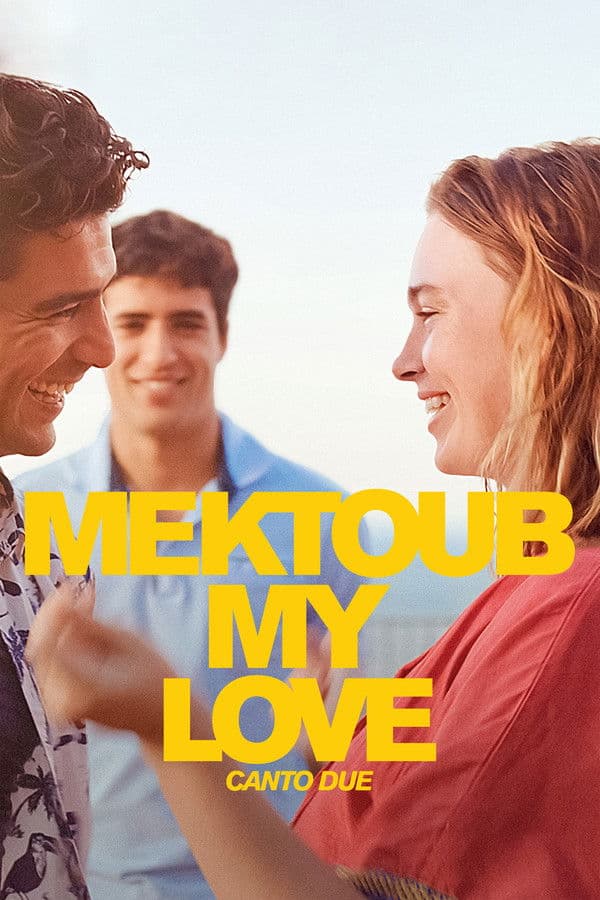
Mektoub, My Love: Canto Due
2025 • Comedy, Drama, Romance
Amin returns to Sète after studying in Paris, still dreaming of cinema. By chance, an American producer on vacation takes an interest in his project and wants his wife, Jess, to play the lead role. But fate, whimsical as ever, has its own rules.
Runtime: 2h 19m
Buy related books from Amazon
As an Amazon Associate I earn from qualifying purchases. Read the full disclosure.
Why you should read the novel
Before you watch Mektoub, My Love: Canto Due, discover the source material that inspired the film’s world: François Bégaudeau’s novel The Real Wound. On the page, the coming-of-age story unfolds with a precision of feeling and a clarity of voice that only prose can deliver, capturing summer’s heat, longing, and indecision in sentences you can linger over.
Reading The Real Wound places you inside the characters’ inner weather—those flickers of memory, jealousy, and desire that rarely make it to the screen. Bégaudeau’s language, whether read in the original French or in translation where available, slows time in the best way, revealing the emotional micro-movements behind every glance on the beach and every risky choice at night.
If you’re drawn to the film’s ambiance, the book gives you more: richer context, deeper motivations, and cultural textures that reward careful reading. Choose the novel to experience the full depth of the story’s themes—youth, class, friendship, and the ache of becoming—before any adaptation reshapes them for the camera.
Adaptation differences
Abdellatif Kechiche’s film series, including Canto Due, takes a markedly observational path compared to François Bégaudeau’s The Real Wound. The novel’s interior monologue and precise authorial voice become visual immersion: long, patient scenes, ambient sound, and glances replace narrated thought. Where the book articulates motives, the film asks viewers to infer them from bodies in motion and silences.
Structure and pacing diverge as well. The prose organizes time around reflection and memory, while the adaptation stretches present-tense moments—parties, beaches, dinners—into extended, experiential sequences. Subplots that read briskly on the page may be minimized, re-ordered, or absorbed into mood-driven tableaux, shifting emphasis from plotted turns to lived texture.
Characterization changes follow from this shift in medium. In the novel, backstory and interior detail sketch relationships with fine-grained clarity; on screen, characterization is externalized through gesture, group dynamics, and prolonged observation. Some roles may be combined, renamed, or redistributed to fit the ensemble flow, trading literary specificity for a more fluid social portrait.
Tone and thematic emphasis also evolve in adaptation. The book balances youthful desire with sharp social and cultural commentary voiced through the narrator’s perspective; the film foregrounds sensorial experience, dance, and physical proximity, letting social context emerge indirectly. While specific scene-by-scene alterations in Canto Due may vary, the overall result is consistent: a looser, more immersive cinematic reimagining that privileges sensation over narration.
Mektoub, My Love: Canto Due inspired from
The Real Wound
by François Bégaudeau