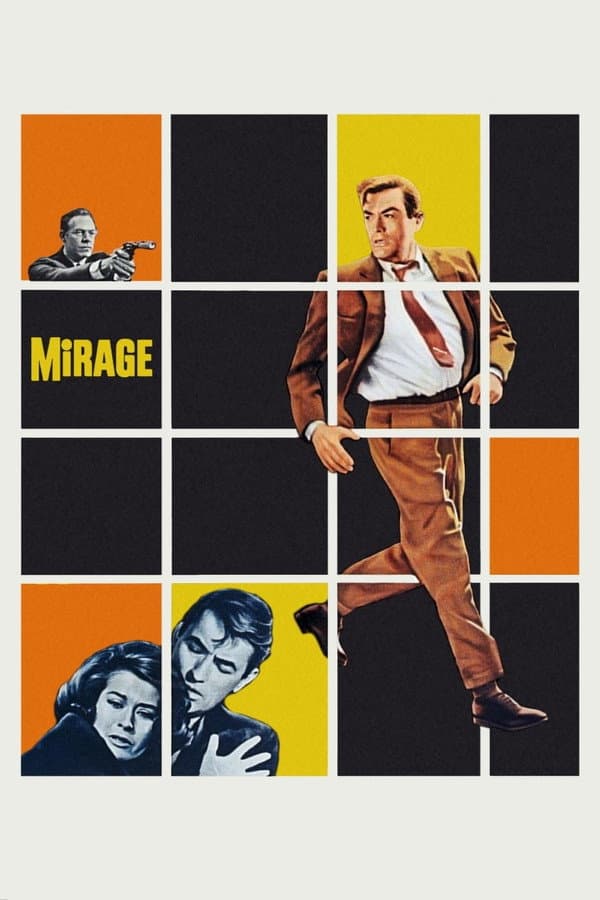
Mirage
1965 • Mystery, Thriller
After a blackout in his office building, accountant David Stillwell emerges outside to find out a man he did not know either jumped or was pushed out a window to his death — and that he can't remember the past two years of his life. Enlisting the help of a rookie private eye and a reluctant old flame, Stillwell uncovers the mystery detail by unexpected detail.
Runtime: 1h 49m
Buy related books from Amazon
As an Amazon Associate I earn from qualifying purchases. Read the full disclosure.
Why you should read the novel
Before you press play on Mirage (1965), pick up Fallen Angel by Howard Fast (as Walter Ericson). The original novel delivers the amnesia-noir tension, corporate intrigue, and psychological twists at the heart of the movie—only with deeper stakes and richer atmosphere.
Fast’s propulsive prose puts you inside the protagonist’s fractured memory, layering clues, betrayals, and social commentary that the film only glances at. If you love classic noir, conspiracy thrillers, and literary suspense, reading Fallen Angel gives you the most complete version of the story.
Searching for “Mirage 1965 book vs movie” or “read Fallen Angel by Howard Fast”? Start with the source novel. It offers fuller backstory, sharper character arcs, and a more nuanced finale—essential for fans who want the definitive experience.
Adaptation differences
Mirage (1965) streamlines the plot of Fallen Angel, compressing investigations and rearranging revelations to maintain pace. Several subplots and strands of political critique in Howard Fast’s novel are trimmed to foreground sleek, studio-era suspense.
Point of view shifts notably. The book leans on intimate interiority and disorienting memory fragments, while the film externalizes clues via dialogue, flashbacks, and set‑piece pursuits—resulting in a more linear, visually driven mystery on screen.
Characterization changes stand out. Supporting figures are merged or renamed, the private detective gains a livelier comic edge in the movie, and antagonists’ motives are simplified; the novel treats these roles with greater nuance and more explicit corporate malfeasance.
Tone and resolution diverge. Fast’s Fallen Angel lingers on moral ambiguity and systemic critique after the truth surfaces, whereas Mirage opts for a cleaner wrap‑up and a heightened romantic throughline, reflecting 1960s studio expectations and audience-friendly closure.
Mirage inspired from
Fallen Angel
by Howard Fast (as Walter Ericson)