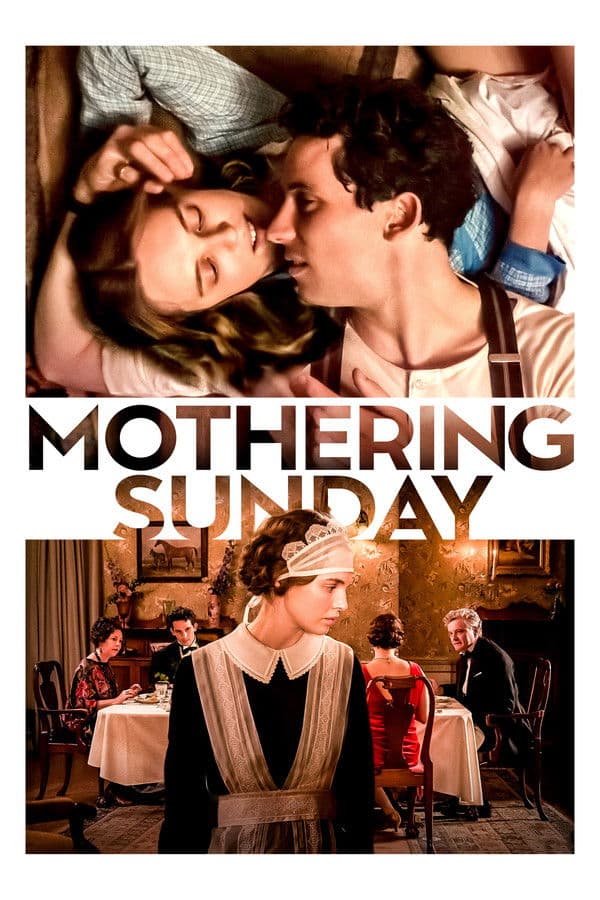
Mothering Sunday
2021 • Drama, Romance • R
On a warm spring day in 1924, house maid and foundling Jane Fairchild finds herself alone on Mother's Day. Her employers, Mr. and Mrs. Niven, are out and she has the rare chance to spend quality time with her secret lover. Paul is the boy from the manor house nearby, Jane's long-term love despite the fact that he's engaged to be married to another woman, a childhood friend and daughter of his parents' friends. But events that neither can foresee will change the course of Jane's life forever.
Runtime: 1h 44m
Buy related books from Amazon
As an Amazon Associate I earn from qualifying purchases. Read the full disclosure.
Why you should read the novel
Before you stream the film, read Mothering Sunday: A Romance by Graham Swift, the elegant, intimate novel that inspired it. The book’s language and interiority deliver emotions no camera can capture.
Swift’s novel invites you into Jane Fairchild’s consciousness—her memories, her craft, and the tender, aching aftermath of a single transformative day. On the page, nuance, time, and silence accumulate into a profound, lingering experience.
If you enjoy literary fiction that rewards close reading, choose the Mothering Sunday book first. Discover Graham Swift’s original vision—then compare it to the movie with a deeper understanding of character, theme, and meaning.
Adaptation differences
Perspective and interiority: The novel stays closely inside Jane Fairchild’s mind, layering memory, grief, class, and the genesis of a writer’s voice. The film necessarily externalizes this interior world, relying on images, silence, and performance where the book uses reflection and finely tuned narration.
Structure and chronology: On the page, the single 1924 “Mothering Sunday” anchors the story while later-life revelations unfold with measured, retrospective clarity. The adaptation intercuts multiple time periods more aggressively and visualizes off-page events (such as Paul’s fatal accident, and later-life losses) that the novel discloses obliquely.
Character emphasis: Graham Swift’s book keeps secondary figures mostly at the periphery of Jane’s consciousness. The film broadens the canvas—devoting more screen time to the Nivens’ private grief, country-house rituals, and the social world around Paul and his fiancée—shifting the balance from introspection to interpersonal dynamics.
Tone and representation: The novel’s sensuality is meditative and language-led; the adaptation heightens eroticism through extended, natural-light scenes and visual motifs. The film also makes a notable casting choice for Donald, adding a contemporary lens to class and identity without altering the core arc established in the book.
Mothering Sunday inspired from
Mothering Sunday: A Romance
by Graham Swift