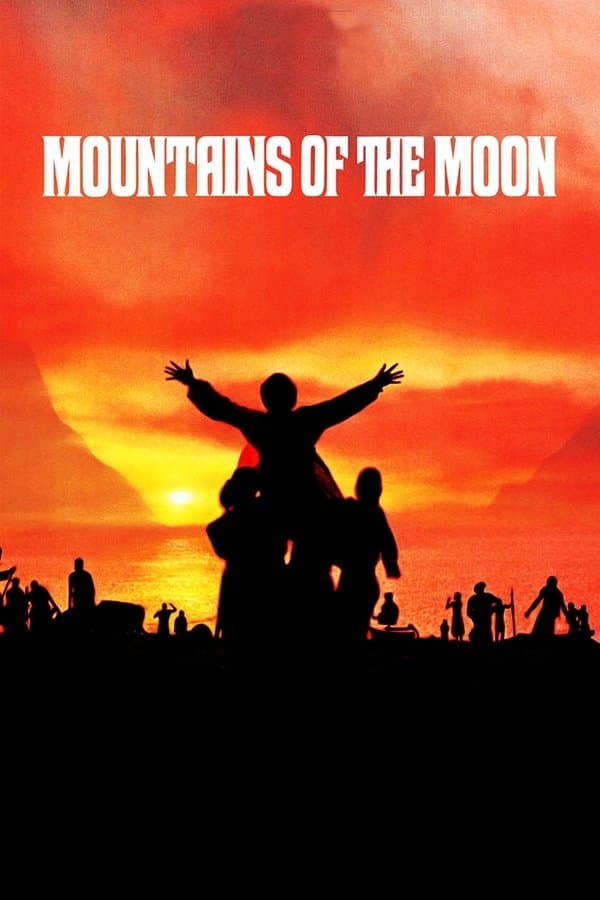
Mountains of the Moon
1990 • Adventure, Drama, History • R
The story of Captain Richard Francis Burton's and Lt. John Hanning Speke's expedition to find the source of the Nile river in the name of Queen Victoria's British Empire.
Runtime: 2h 16m
Buy related books from Amazon
As an Amazon Associate I earn from qualifying purchases. Read the full disclosure.
Why you should read the novel
If Mountains of the Moon (1990) intrigued you, read the powerful novel that inspired it: Burton and Speke by William Harrison. This acclaimed historical adventure immerses you in the true-life quest of Richard Francis Burton and John Hanning Speke to discover the source of the Nile—richer, deeper, and more intimate than any screen version.
Harrison’s book delivers layered character studies, vivid period atmosphere, and meticulous research on Victorian exploration, the Royal Geographical Society, and East African landscapes and cultures. You’ll experience Burton’s brilliant, controversial mind and Speke’s driven determination through nuanced scenes, insightful dialogue, and immersive detail that the movie can only hint at.
For readers who crave authenticity, historical accuracy, and big-idea storytelling, Burton and Speke is the definitive way to engage with this epic tale. Discover the full scope of the expedition, the politics behind it, and the complex friendship at its core by choosing the book over a two-hour film.
Adaptation differences
Scope and perspective: Mountains of the Moon emphasizes cinematic momentum and spectacle, while the novel Burton and Speke devotes far more space to inner lives, motivations, and doubts. On the page, Harrison explores Burton’s intellect and Speke’s insecurities with patient, reflective passages; on screen, those complexities are necessarily streamlined into dialogue and action.
Chronology and events: The film condenses timelines and rearranges or compresses certain journeys to maintain pace and clarity. The novel presents more granular expedition logistics, longer treks, and additional encounters, plus a wider cast of guides, patrons, and rivals. The movie often blends people and incidents into composites to keep the narrative focused.
Themes and context: Harrison’s book digs deeply into Victorian science, class tensions, religion, and the ethics of empire, alongside linguistic and ethnographic observations. The adaptation foregrounds adventure, survival, and interpersonal conflict, softening or abbreviating some political and cultural debates to remain accessible to general audiences.
Character dynamics: On film, the Burton–Speke relationship is framed with sharper contrasts and heightened turning points to anchor dramatic set pieces. In the novel, their partnership and rivalry unfold with greater ambiguity, extended conversations, and shifting perspectives, yielding a more intricate portrait of loyalty, pride, and discovery than the adaptation can fully accommodate.
Mountains of the Moon inspired from
Burton and Speke
by William Harrison