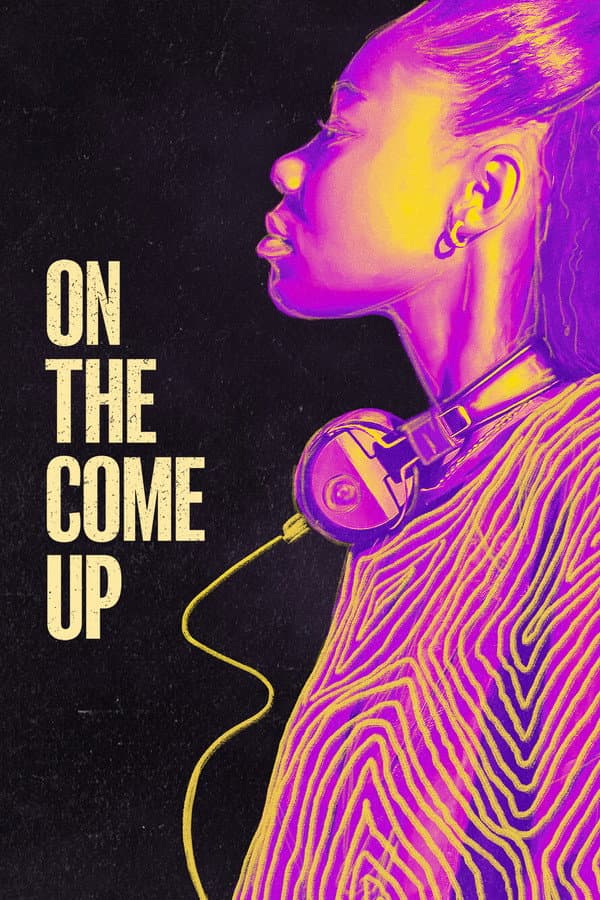
On the Come Up
2022 • Drama, Music • PG-13
Sixteen-year-old Brianna Jackson is a gifted rapper who plans to take the battle rap scene by storm to lift up her family and do right by the legacy of her father, a local hip-hop legend whose career was cut short by gang violence. However, when her first hit song goes viral for all the wrong reasons, she finds herself torn between the authenticity that got her this far and the false persona that the industry wants to impose on her.
Runtime: 1h 55m
Buy related books from Amazon
As an Amazon Associate I earn from qualifying purchases. Read the full disclosure.
Why you should read the novel
Before you press play, consider reading On the Come Up by Angie Thomas, a powerful YA contemporary novel that delivers raw emotion, razor-sharp lyricism, and unforgettable voice. Page by page, Bri’s internal monologue, bars, and creative process come alive in ways only a book can, giving you intimate access to her ambitions, fears, and triumphs.
Angie Thomas—bestselling author of The Hate U Give—builds a layered world of family, friendship, and community where every choice has weight. The novel explores art, identity, and resilience with depth and nuance, inviting readers to reflect on authenticity, censorship, and what it really means to “make it” on your own terms.
If you’re searching for a rich, character-driven story with immersive detail and social insight, the book offers more context, more heart, and more lyrical punch than any two-hour runtime. Read the source material to experience Bri’s journey exactly as the author envisioned it, and discover why this novel is a cornerstone of modern YA fiction.
Adaptation differences
The film adaptation streamlines the novel’s timeline and condenses several plot threads to fit a feature-length format. As a result, the movie emphasizes momentum and showcase performances, while the book lingers on Bri’s writing process, school life, and the day-to-day pressures shaping her art. Readers will notice that the page offers more quiet moments, introspection, and detailed buildup to each turning point.
Character dynamics are also simplified on screen. Some side characters receive less development or combined functions, and certain relationships shift in emphasis to keep the narrative focused on Bri’s rapid rise. In the novel, friendships, rivalries, and family bonds unfold with greater texture, revealing how community expectations and personal loyalties pull Bri in competing directions.
Tonal choices differ notably. The movie softens or refocuses some of the book’s harsher realities—particularly around neighborhood tensions and industry pressures—opting for a more uplifting, performance-forward arc. The novel dives deeper into systemic issues, school disciplinary bias, and the complicated ethics of marketing an image, giving readers a fuller picture of the stakes behind each lyric and decision.
The resolutions diverge in feel. While the film builds to a cathartic, crowd-pleasing climax centered on stage impact, the book’s conclusion more deliberately interrogates artistic integrity, ownership, and the cost of compromise. On the page, you sit with Bri’s choices longer, witnessing how she reclaims her voice and negotiates power—an arc that lands with added resonance in the source material.
On the Come Up inspired from
On the Come Up
by Angie Thomas
