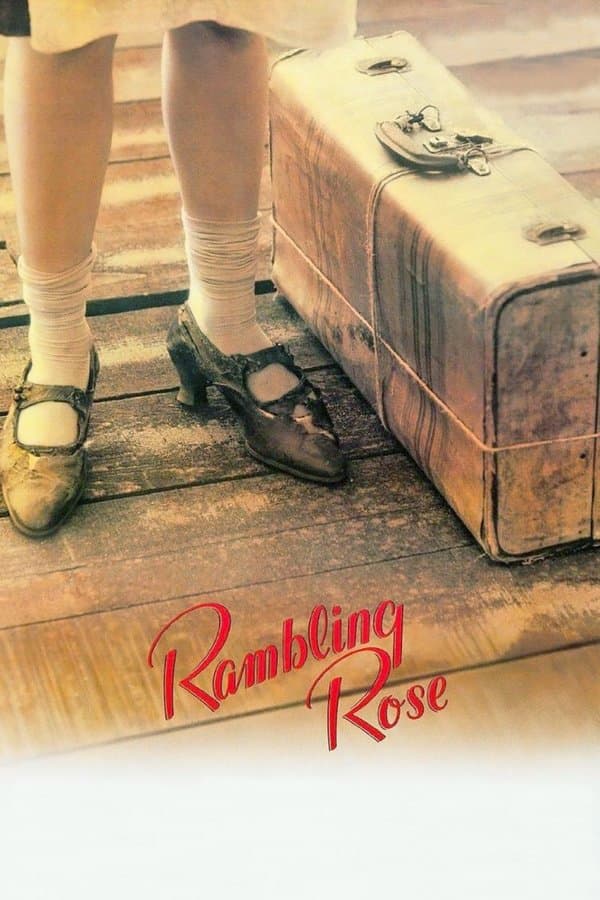
Rambling Rose
1991 • Drama • R
In the Deep South of the 1930s, Rose is taken in by the Hillyer family to serve as housemaid so that she can avoid falling into a life of prostitution. Her appearence and personality is such that all men fall for her, and she knows it. She can't help herself from getting into trouble with men.
Runtime: 1h 52m
Buy related books from Amazon
As an Amazon Associate I earn from qualifying purchases. Read the full disclosure.
Why you should read the novel
Discover the Rambling Rose novel by Calder Willingham—the moving, provocative coming-of-age story that inspired the 1991 film. On the page, Rose’s voice and the Hillyer family’s world unfold with greater nuance, letting readers linger inside their motivations, contradictions, and small-town Southern textures that a two-hour movie can only suggest.
If you’re searching for Rambling Rose book vs movie insights, start with the source material. Willingham’s prose blends tenderness with sharp social observation, delivering a richer exploration of desire, class, gender expectations, and moral hypocrisy. The Rambling Rose book rewards readers who crave layered character work and emotionally candid storytelling that resonates long after the last chapter.
Before you rewatch the film, read the Rambling Rose novel to experience scenes, interior reflections, and historical shading that never made it to the screen. Available in print and audiobook, Calder Willingham’s original vision offers the most complete, compelling version of Rose’s journey and Buddy’s awakening.
Adaptation differences
Differences between the Rambling Rose book and movie begin with perspective and interiority. The novel gives fuller access to Rose’s and Buddy’s inner lives—their private rationalizations, shame, curiosity, and tenderness—whereas the film must externalize those feelings through performance and visual storytelling. This shift naturally narrows certain psychological shadings that the prose sustains across entire chapters.
Tone and frankness also diverge. Calder Willingham’s novel is more explicit and provocative about sexuality and Southern respectability, using candid language and sharper satire. The film adopts a gentler, nostalgic register, often implying what the book states outright to fit mainstream expectations and runtime, softening edges without abandoning the story’s compassion.
Structurally, the adaptation compresses time, trims minor townspeople, and reduces or merges subplots. The book dwells longer on community gossip, class anxieties, and the complex push-pull within the Hillyer household, while the movie streamlines these elements to keep focus on Rose’s impact on the family. Several episodes that are extended in the novel become brief grace notes on screen—or are omitted entirely.
Finally, emphasis and aftertaste differ. The film leans into warmth, reconciliation, and a reflective coming-of-age glow, while the novel’s resolution feels more ambivalent, lingering on the costs of desire, the limits of propriety, and the contradictions of Southern manners. Readers will find the book’s thematic contours—agency, judgment, forgiveness—rendered with a complexity the adaptation can only partially echo.
Rambling Rose inspired from
Rambling Rose
by Calder Willingham