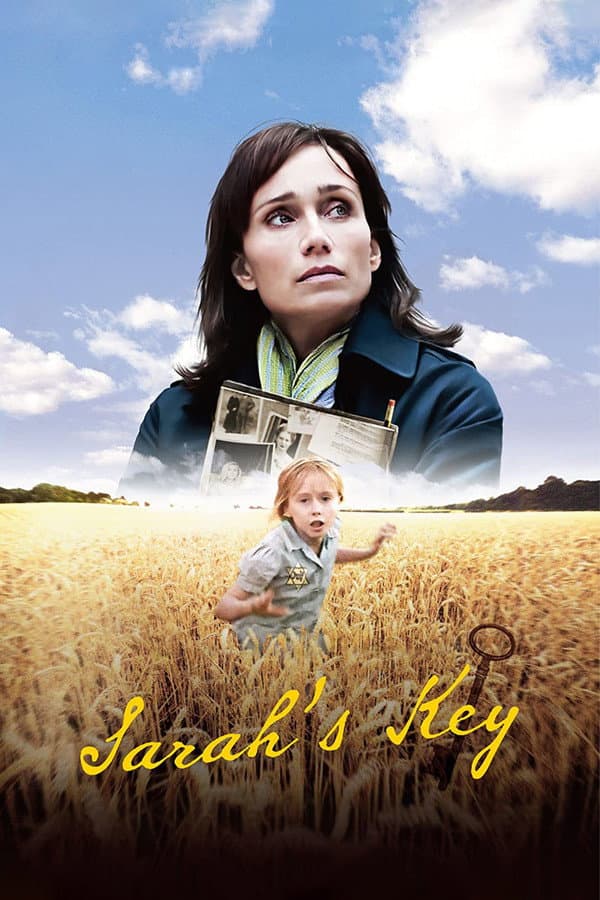
Sarah's Key
2010 • Drama, War • PG-13
On the night of 16 July 1942, ten year old Sarah and her parents are being arrested and transported to the Velodrome d'Hiver in Paris where thousands of other jews are being sent to get deported. Sarah however managed to lock her little brother in a closet just before the police entered their apartment. Sixty years later, Julia Jarmond, an American journalist in Paris, gets the assignment to write an article about this raid, a black page in the history of France. She starts digging archives and through Sarah's file discovers a well kept secret about her own in-laws.
Runtime: 1h 51m
Buy related books from Amazon
As an Amazon Associate I earn from qualifying purchases. Read the full disclosure.
Why you should read the novel
Before pressing play on the film, consider opening Tatiana de Rosnay’s novel Sarah’s Key. The book immerses you in a layered, intimate narrative that moves between wartime Paris and a modern investigation, unfolding with a depth only prose can sustain. Its pages offer the kind of psychological nuance, historical texture, and slow-burn suspense that reward careful, empathetic reading.
Reading Sarah’s Key lets you inhabit the characters’ inner worlds—Sarah’s haunting memories and Julia’s moral awakening—with a closeness that a two-hour movie can only hint at. De Rosnay’s evocative detail brings the Vel’ d’Hiv roundup, hidden lives, and intergenerational silence into sharper relief, transforming history from backdrop into lived experience. Each chapter lingers, building resonance and meaning.
If you’re drawn to powerful historical fiction and investigative dramas, the novel delivers a fuller, richer journey. You’ll uncover additional threads, backstories, and revelations that illuminate identity, guilt, and responsibility. Turn to the source to experience the story at its most complete and affecting—and to carry its echoes long after the final page.
Adaptation differences
Both the film and the novel use a dual timeline, but the book alternates perspectives with greater regularity and patience. Sarah’s wartime arc and Julia’s contemporary investigation unwind across more chapters in print, allowing the cause-and-effect to accumulate gradually. The movie streamlines chronology to maintain cinematic momentum, condensing certain searches and transitions.
Character development is more expansive in the novel. Julia’s marriage, pregnancy, professional pressures, and moral conflict receive extended focus, while the Tezac family’s history and complicity are explored in greater detail. On screen, several secondary characters and subplots are compressed or combined, sharpening the spotlight on a few pivotal relationships and key revelations.
The book provides broader historical and sensory context. Scenes around the Vel’ d’Hiv roundup, detention, rural hiding, and postwar displacement include richer period detail and interior reflection. The adaptation conveys these episodes visually and efficiently but with less access to characters’ inner monologue, shifting some of the emotional weight from reflection to performance and image.
Their conclusions differ in emphasis and scope. The novel follows the aftermath further, tracing how discoveries reshape identities and relationships over time, and it dwells longer on the legacy carried by subsequent generations. The film reaches emotional closure more quickly after major revelations, presenting Sarah’s later life and its consequences more succinctly while foregrounding catharsis over the novel’s extended contemplation.
Sarah's Key inspired from
Sarah's Key
by Tatiana de Rosnay