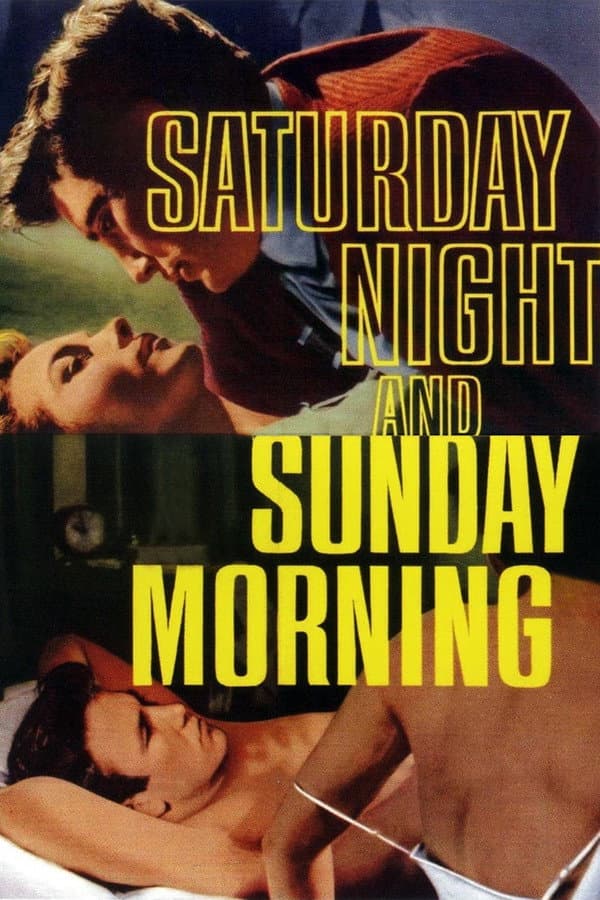
Saturday Night and Sunday Morning
1960 • Drama, Romance
A 22-year-old factory worker lets loose on the weekends: drinking, brawling, and dating two women, one of whom is older and married.
Runtime: 1h 30m
Buy related books from Amazon
As an Amazon Associate I earn from qualifying purchases. Read the full disclosure.
Why you should read the novel
Before you press play on the 1960 film, read Alan Sillitoe’s original novel Saturday Night and Sunday Morning for the most complete, authentic version of Arthur Seaton’s story. The book plunges you into postwar Nottingham with raw immediacy, capturing working-class rhythms, factory grind, pub life, and the rebellious voice that defined British realism.
The source novel delivers layers the camera can’t capture: textured dialect, inner thoughts, and social detail that illuminate every choice Arthur makes. Sillitoe’s prose gives you a richer sense of class tension, desire, and defiance—perfect for readers who want the definitive Saturday Night and Sunday Morning reading experience.
If you’re deciding between the movie and the book, choose the novel to get the unfiltered themes, bold language, and psychological depth that censorship and runtime trimmed on-screen. Discover why Alan Sillitoe’s Saturday Night and Sunday Morning remains a landmark of British literature and a cornerstone of working-class storytelling.
Adaptation differences
Book vs film: the Alan Sillitoe novel offers far more interiority and voice than the 1960 adaptation can convey. The book dives deeply into Arthur Seaton’s thought processes—his impulses, resentments, and self-justifications—while the movie must externalize through performance, dialogue, and action. This tonal shift softens some of Arthur’s harshest edges and reduces the novel’s relentless, intimate stream of working-class consciousness.
Scope and detail differ significantly between the book and the movie. The novel’s Nottingham is expansive—factory floors, family rituals, pubs, fairgrounds, and neighborhood textures—whereas the film condenses events, streamlines supporting characters, and compresses time to fit its brisk runtime. As a result, the adaptation trims political nuance, labor context, and social observation that the book develops patiently.
Censorship and explicitness mark another key difference between the adaptation and the book. The 1960 film handles sex, Brenda’s pregnancy, abortion, and profanity with euphemism and restraint, while the novel is frank about desire, clandestine decisions, and the consequences that follow. Readers will find the book’s language and situations more candid and revealing than what could be shown on screen at the time.
Ending and thematic emphasis also diverge in this book-to-film transition. The movie nudges Arthur toward domestic stability with Doreen and lands on a cautiously optimistic note; the novel’s conclusion is more ambivalent, preserving his defiance while acknowledging the pressures to conform. In short, the adaptation streamlines plot and softens edges, whereas the book sustains a sharper social critique and a more complex, unresolved portrait of Arthur.
Saturday Night and Sunday Morning inspired from
Saturday Night and Sunday Morning
by Alan Sillitoe