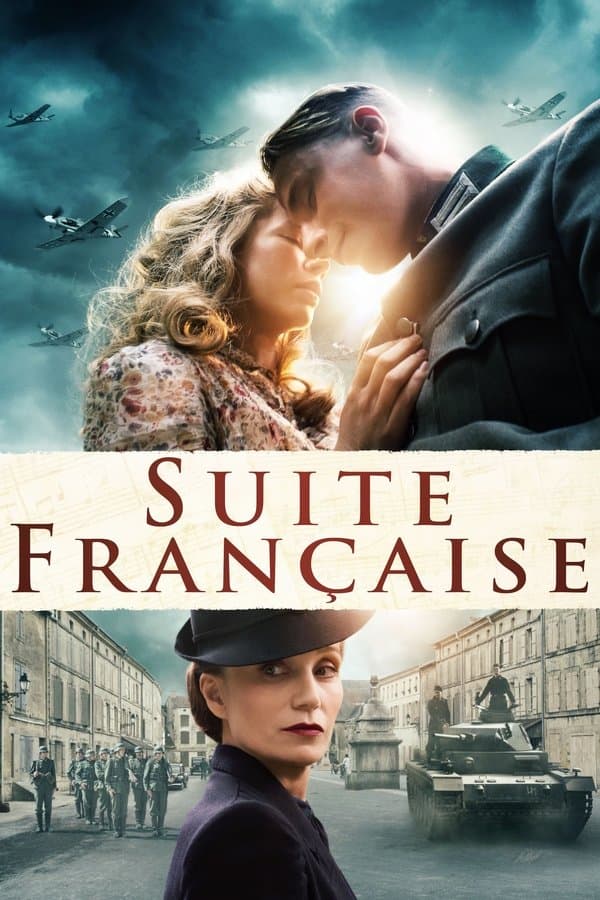
Suite Française
2015 • Drama, Romance, War • NR
France, 1940. In the first days of occupation, beautiful Lucile Angellier is trapped in a stifled existence with her controlling mother-in-law as they both await news of her husband: a prisoner of war. Parisian refugees start to pour into their small town, soon followed by a regiment of German soldiers who take up residence in the villagers' own homes. Lucile initially tries to ignore Bruno von Falk, the handsome and refined German officer staying with them. But soon, a powerful love draws them together and leads them into the tragedy of war.
Runtime: 1h 43m
Buy related books from Amazon
As an Amazon Associate I earn from qualifying purchases. Read the full disclosure.
Why you should read the novel
Before you press play, open Irène Némirovsky’s Suite Française. Written in real time during the Second World War, this landmark novel delivers an immediacy and moral clarity no screen can replicate.
On the page, you’ll journey through both Storm in June and Dolce—the chaotic Paris exodus and the charged calm of rural occupation—encountering dozens of vivid lives, layered class tensions, and the subtle, shifting allegiances that define survival under tyranny.
The acclaimed English edition preserves Némirovsky’s luminous prose and includes illuminating contextual materials. If you want the fullest, richest version of this story’s heartbreak, courage, and nuance, read the book—then decide if you still need the movie.
Adaptation differences
Scope and structure diverge first. The film primarily adapts Dolce, centering on Lucile and the billeted German officer, while the novel also contains Storm in June, a sweeping portrait of the Paris exodus that the movie omits entirely.
Tone and emphasis shift notably. Némirovsky’s book balances romance with sharp social observation—class snobbery, petty cruelties, and reluctant compromises—whereas the adaptation foregrounds a more direct love story and streamlines the village’s complex web of relationships and moral ambiguities.
Character arcs are reshaped for cinema. The novel keeps Lucile and Bruno’s attraction delicate, constrained, and ambiguous; the movie heightens passion, adds suspenseful set pieces, and literalizes the title through Bruno’s musical motif, creating a clearer, more conventionally romantic arc than the book’s restraint.
Endings and closure differ. Suite Française the novel is an incomplete masterpiece—open-ended by circumstance and design—while the film supplies resolution for key characters and conflicts, offering definitive beats that the book purposely withholds.
Suite Française inspired from
Suite Française
by Irène Némirovsky