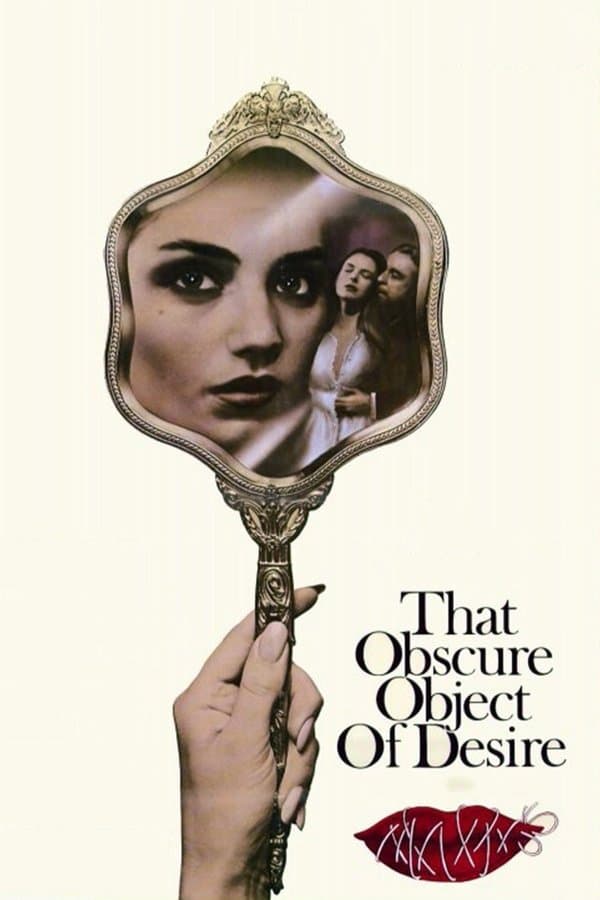
That Obscure Object of Desire
1977 • Comedy, Drama, Romance • R
After dumping a bucket of water on a beautiful young woman from the window of a train car, wealthy Frenchman Mathieu, regales his fellow passengers with the story of the dysfunctional relationship between himself and the young woman in question, a fiery 19-year-old flamenco dancer named Conchita. What follows is a tale of cruelty, depravity and lies -- the very building blocks of love.
Runtime: 1h 43m
Buy related books from Amazon
As an Amazon Associate I earn from qualifying purchases. Read the full disclosure.
Why you should read the novel
Skip the screen and surrender to Pierre Louÿs’ The Woman and the Puppet, a classic of psychological seduction set in Belle Époque Spain. The novel’s intimate confession, sun‑soaked Seville, and the unforgettable Concha Pérez offer a rich, provocative counterpart to any adaptation.
Louÿs’ prose captures the heat of patios, Holy Week pageantry, and the perilous dance of jealousy and control with a sophistication movies rarely match. The book’s layered voice and careful observation turn every glance, promise, and refusal into high drama, revealing why this tale has inspired generations of filmmakers.
For readers drawn to classic literature, sensual psychology, and cultural history, The Woman and the Puppet delivers the complete experience—unabridged themes, nuanced motivations, and period detail. Discover the source that shaped modern erotic obsession narratives and understand the story’s deeper ironies before you press play.
Adaptation differences
Narrative perspective and character design shift dramatically from page to screen. In the novel, Don Mateo relates his obsession as a confessional tale, creating a singular voice and moral lens. Buñuel’s film has Mathieu, a wealthy French businessman, narrate to strangers on a train—and famously splits Conchita between two actresses, Carole Bouquet and Ángela Molina, turning a unified literary character into an intentionally fragmented enigma.
Time and setting also diverge in telling ways. Pierre Louÿs places the action in Belle Époque Seville amid carnivals and Catholic ritual, where social codes and honor intensify desire and restraint. Buñuel relocates the story to the 1970s and threads it through contemporary France and Spain, punctuating scenes with terrorist incidents. This modern backdrop reframes the lovers’ cruelty as part of a wider climate of anxiety and random violence.
Power dynamics evolve with these changes. The book’s Don Mateo is a Spaniard ensnared by a younger Andalusian woman in a society of strict appearances, while the film’s Mathieu is an older, affluent Frenchman whose class privilege collides with Conchita’s economic precarity. Buñuel’s two‑actress device amplifies contradiction—innocence and provocation, sincerity and deceit—whereas Louÿs develops Concha’s strategies through consistent behavior, social negotiation, and the era’s obsession with virtue.
Endings and tone finalize the contrast. Louÿs moves toward possession followed by disillusionment, exposing the hollowness of conquest in a decadent milieu. Buñuel opts for ambiguity and irony: an image of mending lace, a sudden explosion, and unresolved desire. The film leans into surrealist satire and episodic ellipses, while the novel sustains a more linear, confessional propulsion—two distinct experiences from the same magnetic source.
That Obscure Object of Desire inspired from
The Woman and the Puppet
by Pierre Louÿs