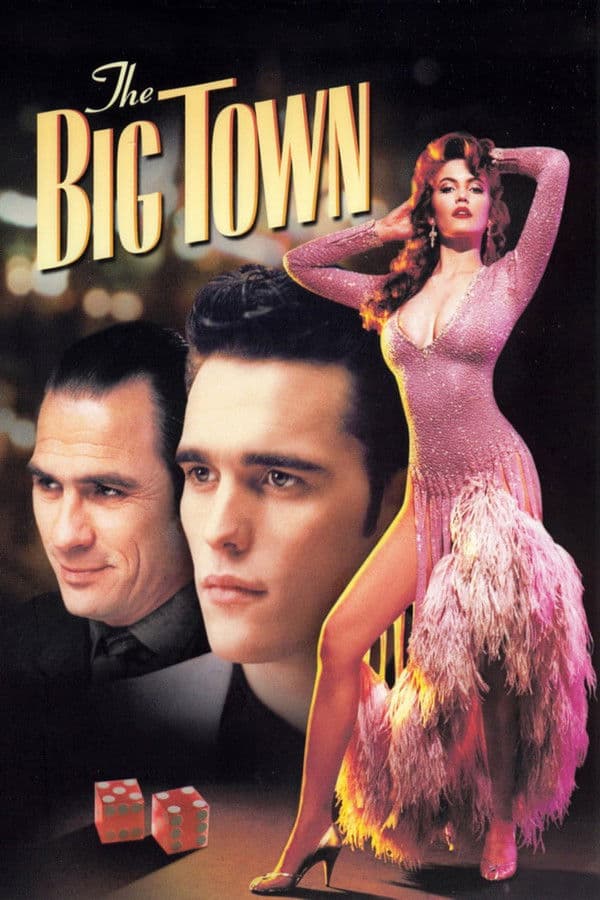
The Big Town
1987 • Drama, Romance • R
It is 1957. J.C. Cullen is a young man from a small town, with a talent for winning at craps, who leaves for the big city to work as a professional gambler. While there, he breaks the bank at a private craps game at the Gem Club, owned by George Cole, and falls in love with two women, one of them Cole's wife.
Runtime: 1h 49m
Buy related books from Amazon
As an Amazon Associate I earn from qualifying purchases. Read the full disclosure.
Why you should read the novel
If The Big Town (1987) hooked you on high-stakes craps and Chicago’s after-hours mystique, Clark Howard’s novel The Arm is the definitive way to experience it. The book delivers a richer, street-level immersion into the gambling underworld that inspired the film.
Reading The Arm places you inside the rooms, rules, and rituals of dice shooting, with the tight, suspenseful prose of an award-winning crime writer. You’ll get the nuance, backstory, and motivation that a two-hour movie can only hint at—perfect for fans of gritty, character-driven crime fiction.
For anyone debating book vs. movie, the source novel wins on depth, authenticity, and atmosphere. Discover the layered psychology of gamblers, the mechanics of the hustle, and a Chicago that breathes beyond the screen—ideal for collectors of classic American noir and hardboiled fiction.
Adaptation differences
Scope and pacing are the most noticeable differences between The Big Town movie and Clark Howard’s The Arm. The film streamlines events into a sleek, cinematic arc, while the novel ranges wider, taking time to map out the gambling ecosystem—rooms, bosses, fixers, and the street rules that govern every throw.
Character depth also diverges. On screen, several side figures are compressed or omitted to keep the story focused. In the book, mentors, rivals, and hangers-on receive fuller backstories and clearer motivations, and the protagonist’s inner voice adds moral ambiguity and tension the film can only suggest.
Tone and texture shift as well. The movie leans into period style—music, neon, and romance—whereas the novel reads more hardboiled and procedural, unpacking dice mechanics, cheating techniques, superstitions, and the unglamorous grind that underpins each bet. That granular realism heightens stakes in ways the adaptation often visualizes rather than explains.
Finally, the outcomes and emphasis change. The film favors a more conclusive, audience-friendly resolution and concentrates on a central love-and-danger throughline. The book allows for messier consequences and slower-burn reckonings within the gambling world, leaving readers with a more ambiguous, lived-in portrait of risk, luck, and cost.
The Big Town inspired from
The Arm
by Clark Howard