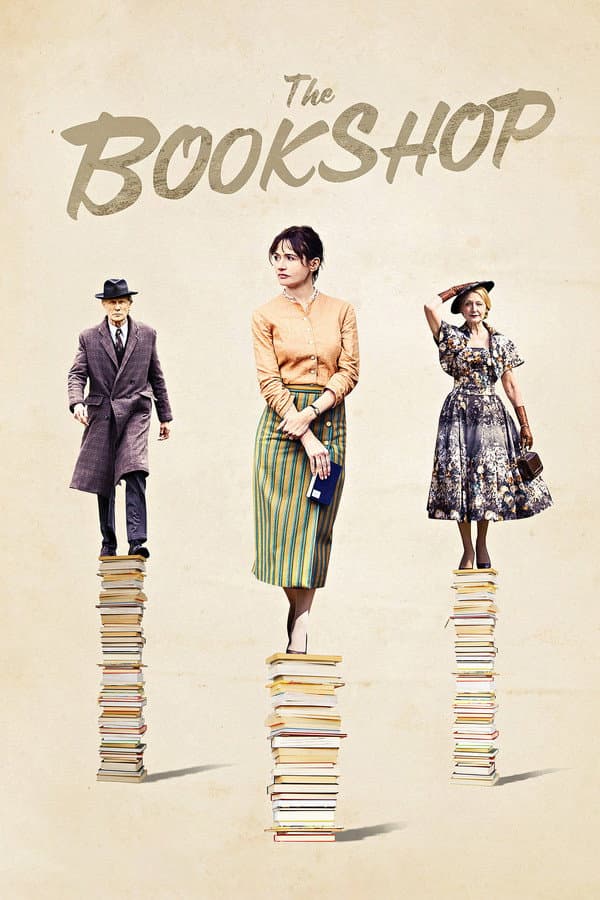
The Bookshop
2017 • Drama
Set in a small English town in 1959, a woman decides, against polite but ruthless local opposition, to open a bookshop, a decision which becomes a political minefield.
Runtime: 1h 50m
Buy related books from Amazon
As an Amazon Associate I earn from qualifying purchases. Read the full disclosure.
Why you should read the novel
Discover the Booker Prize–shortlisted novel The Bookshop by Penelope Fitzgerald, the elegant, incisive source behind the 2017 film. Fitzgerald’s compact, razor-sharp prose illuminates small-town power plays, moral courage, and the stubborn magic of reading with wit and understatement no screen can fully capture.
On the page, Florence Green’s inner life, Christine’s quicksilver intelligence, and Mr. Brundish’s fierce loyalty unfold with the nuance of literary fiction. Fitzgerald’s sly humor and quietly devastating observations—plus the eerie “rapper” haunting the Old House—create textures and tensions that reward slow, attentive reading.
If you loved the movie’s atmosphere, the novel offers deeper stakes, richer context, and keener irony. Read The Bookshop to experience Fitzgerald’s original vision: a timeless portrait of community, conscience, and the controversy of selling Lolita that still feels startlingly contemporary.
Adaptation differences
While the 2017 adaptation preserves the coastal mood and conflict, the Penelope Fitzgerald novel has a sharper satirical edge. The book’s third-person narration, alive with dry irony and interior nuance, becomes a reflective voice-over in the film (framed by an older Christine), shifting tone from ironic to elegiac.
Character emphasis changes, too. The film gives Florence and Mr. Brundish more face-to-face moments and a tender, near-romantic shading; on the page, much of their bond unfolds through letters and reticence. Violet Gamart’s antagonism is rendered more overtly villainous on screen, whereas the novel’s critique of social power is cooler, subtler, and more bureaucratic.
Key plot mechanics are streamlined for cinema. In the novel, Violet leverages high-level influence—ultimately a parliamentary-style maneuver—to dislodge Florence from the Old House. The film simplifies this to local arts-center politics. Timelines are compressed, minor figures are merged or reduced, and the controversy over selling Lolita is framed more centrally as the public flashpoint than in the book’s wider web of pressures.
The endings diverge markedly. The film concludes with the Old House in flames—set alight by Christine—offering a cathartic image and a clear break with Hardborough’s complacency. Fitzgerald’s novel ends more quietly and stingingly: Florence is edged out, the Old House is repurposed as an arts centre, and the lingering sense of loss—tempered by ironic observation—lands with a subtler, longer aftertaste.
The Bookshop inspired from
The Bookshop
by Penelope Fitzgerald