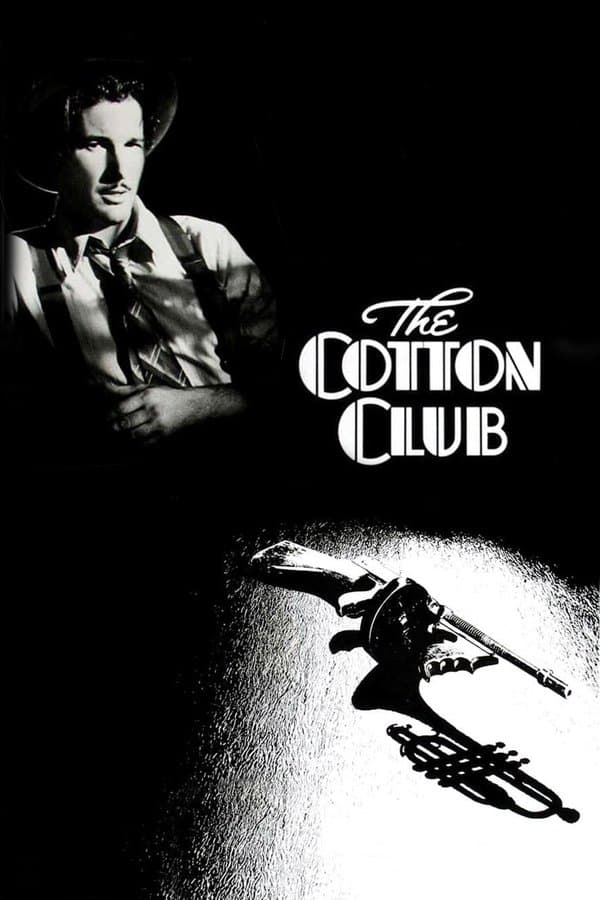
The Cotton Club
1984 • Crime, Drama • R
Harlem's legendary Cotton Club becomes a hotbed of passion and violence as the lives and loves of entertainers and gangsters collide.
Runtime: 2h 10m
Buy related books from Amazon
As an Amazon Associate I earn from qualifying purchases. Read the full disclosure.
Why you should read the novel
Before you press play on the movie, step into James Haskins’ The Cotton Club for the authoritative story behind Harlem’s most iconic nightclub. This deeply researched history immerses you in the real Jazz Age, revealing the cultural forces, legends, and nightlife that shaped an American era.
Reading the book offers context the film can’t match: the club’s origins, how Prohibition and organized crime intersected with show business, and the realities of segregation that defined who performed, who profited, and who was allowed in the audience. It is essential reading for anyone interested in Harlem Renaissance history, jazz history, and the truth behind the myth.
Discover the authentic voices, documented events, and vivid portraits of figures like Duke Ellington and Cab Calloway, alongside the managers and mobsters who pulled the strings. For a richer, more complete understanding of The Cotton Club’s legacy, read the source book first and let the movie become a stylish companion rather than the main course.
Adaptation differences
James Haskins’ The Cotton Club is non-fiction—an investigative history of the nightclub, its performers, owners, and cultural impact—while Francis Ford Coppola’s film is a fictionalized crime-romance set against that backdrop. The movie uses the club as a glamorous stage for a noir-inflected melodrama; the book reconstructs the institution’s real-world evolution, economics, and racial politics.
The film centers on invented or composite characters—such as musician-actor Dixie Dwyer and tap dancer Sandman Williams—who stand in for types and tensions of the era. Haskins, by contrast, profiles actual people and documents verifiable events, offering granular detail on bandleaders, chorus lines, managers, and the networks that made the club run.
Where the movie compresses timelines and heightens gangland intrigue and interracial romance for narrative drive, the book emphasizes ownership, booking practices, pay scales, police pressures, and the club’s segregated audience policy. Haskins treats race, power, and profit as core subjects; the film often treats them as atmospheric elements framing personal dramas.
Musically, the movie foregrounds stylized numbers and montage to evoke the period, especially in later restorations, while the book situates songs, orchestras, and dancers within industry mechanics and historical context. Haskins follows the club beyond the film’s arc, tracing broader shifts across the Jazz Age, the Depression, and changing tastes—coverage that the screen adaptation streamlines or omits.
The Cotton Club inspired from
The Cotton Club
by James Haskins