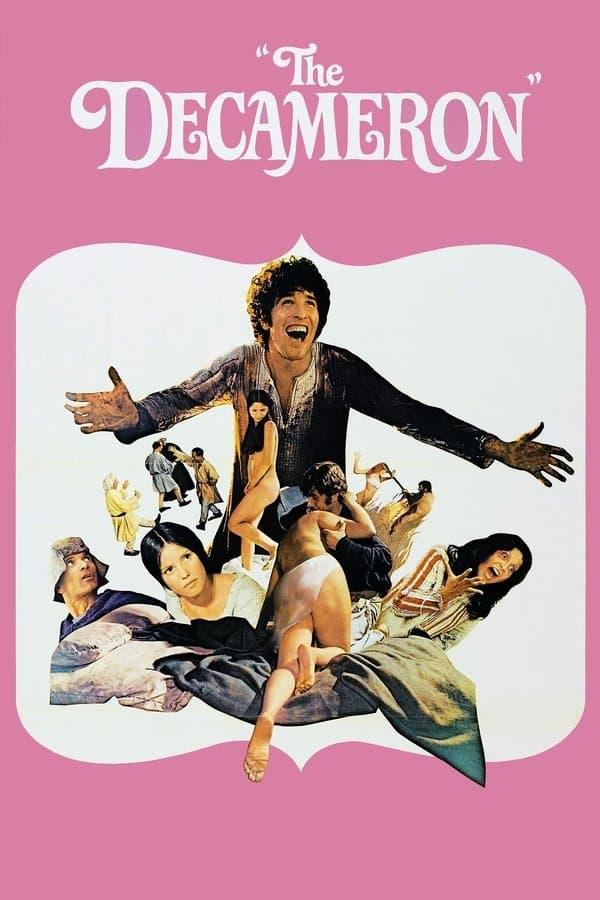
The Decameron
1971 • Comedy, Drama, History • R
A young Sicilian is swindled twice, but ends up rich; a man poses as a deaf-mute in a convent of curious nuns; a woman must hide her lover when her husband comes home early; a scoundrel fools a priest on his deathbed; three brothers take revenge on their sister's lover; a young girl sleeps on the roof to meet her boyfriend at night; a group of painters wait for inspiration; a crafty priest attempts to seduce his friend's wife; and two friends make a pact to find out what happens after death.
Runtime: 1h 51m
Buy related books from Amazon
As an Amazon Associate I earn from qualifying purchases. Read the full disclosure.
Why you should read the novel
Before watching the film, read The Decameron by Giovanni Boccaccio to experience the complete framed narrative of ten storytellers fleeing the Black Death and sharing one hundred brilliant tales of love, wit, fortune, and survival. This medieval Italian masterpiece shaped European literature and offers context, nuance, and humor the movie can only sample.
Modern English translations of The Decameron are lively, clear, and annotation-rich, making Boccaccio’s satire, romance, and social commentary accessible and fun. You’ll discover memorable characters, sharp observations on class and power, and dazzling storytelling patterns arranged by day and theme—material far deeper than any single screen adaptation.
If you want the fullest plotlines, original morals, and the intellectual playfulness behind the stories, choose the book. Reading The Decameron delivers the unabridged experience, historical framing, and authorial intent that no film can replicate—perfect for literature lovers, students, and curious viewers alike.
Adaptation differences
The biggest difference between The Decameron book and the 1971 movie is structure. Boccaccio’s original uses a frame: ten young Florentines escape the plague and tell one hundred stories over ten days. The film discards that framing device, selects only a handful of tales, relocates the action largely to Naples, and adds a new meta-artist thread featuring a painter (played by Pasolini) reflecting on creation.
Tone and emphasis also diverge. The book balances bawdy comedy with moral reflection, subtle satire, and thematic order (each day has a guiding topic). The film heightens corporeality and visual humor, foregrounds sex and earthy realism, and downplays the storytellers’ debates, songs, and moral commentary that color Boccaccio’s text.
Language and storytelling methods create further differences. On the page, each novella includes introductions, transitions, and epilogues that shape interpretation. On screen, Pasolini favors nonprofessional actors, dialect, improvisational textures, and wordless or musically driven sequences, sometimes compressing plots, merging episodes, or altering endings to serve cinematic rhythm rather than Boccaccio’s careful rhetorical design.
Scope and characterization change as well. The book’s hundred tales showcase wide social strata and a curated progression of themes—fortune, cleverness, love, and trickery—guided by rotating kings and queens of each storytelling day. The film necessarily narrows this panorama, reduces or reshapes characters, omits the narrators’ personalities, and adds self-referential commentary about art-making, yielding a vivid but partial portrait of Boccaccio’s expansive original.
The Decameron inspired from
The Decameron
by Giovanni Boccaccio

