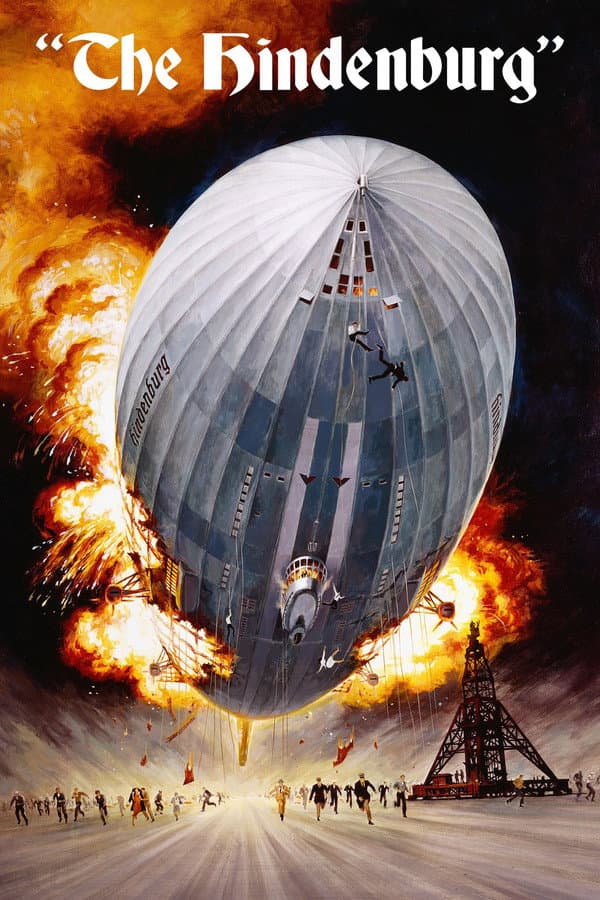
The Hindenburg
1975 • Drama, History, Thriller • PG
Colonel Franz Ritter, a former hero pilot now working for military intelligence, is assigned to the great Hindenburg airship as its chief of security. As he races against the clock to uncover a possible saboteur aboard the doomed zeppelin he finds that any of the passengers and crew could be the culprit.
Runtime: 2h 5m
Buy related books from Amazon
As an Amazon Associate I earn from qualifying purchases. Read the full disclosure.
Why you should read the novels
If you’re fascinated by the Hindenburg disaster, start with the books behind The Hindenburg (1975). Michael M. Mooney’s The Hindenburg and A. A. Hoehling and Mary Hoehling’s Who Destroyed the Hindenburg? deliver historical depth the movie can’t match.
These authoritative, English-language histories assemble eyewitness testimony, flight logs, engineering details, and political context from 1930s Germany and the Zeppelin program—ideal for readers who want aviation history grounded in documented facts and sources, not just spectacle.
Reading the source books gives you a fuller picture of LZ 129’s final voyage, competing theories about the explosion, and the real people aboard the airship—making them essential companions or alternatives to a single two-hour dramatization.
Adaptation differences
Tone and approach: The Hindenburg (1975) builds a fictional cat-and-mouse sabotage investigation and melodramatic subplots, while the books are investigative nonfiction that weigh evidence, interview records, and technical reports without invented protagonists or thriller beats.
Cause of disaster: The movie commits to a bomb plot for narrative payoff. Mooney’s The Hindenburg treats sabotage as a hypothesis, and Hoehling’s Who Destroyed the Hindenburg? advances a controversial suspect theory—both present conjecture and competing explanations, not the cinematic certainty shown on screen.
Characters and names: The adaptation uses composites and renamed figures (including a security officer and a saboteur character) to streamline suspense and heighten conflict. The books discuss real crew and passengers by name, placing them in documented historical and technical contexts instead of reshaping them for drama.
Scope and detail: The film compresses timelines and simplifies airship operations. The books delve into Zeppelin engineering, hydrogen handling, weather influences, ground-crew procedures, and the propaganda role of LZ 129 in Nazi Germany—granular background largely sidelined in the movie’s concise, suspense-driven structure.
The Hindenburg inspired from
The Hindenburg
by Michael M. Mooney
Who Destroyed the Hindenburg?
by A. A. Hoehling, Mary Hoehling