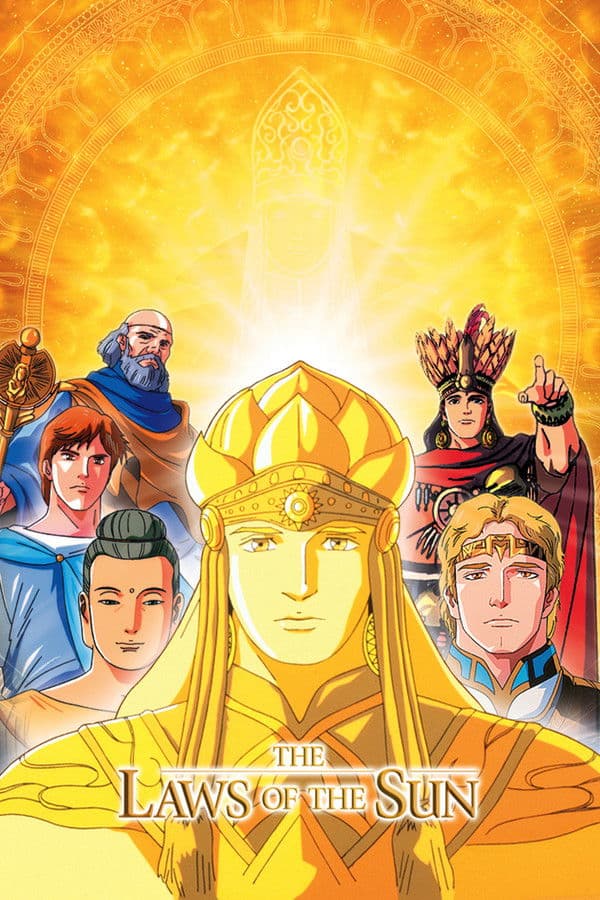
The Laws of the Sun
2000 • Animation, Fantasy, History
Some 120 million years ago, a king named Satan fell to hell and instigated a rebellion against gods, all kinds of confusion and evil effects began to occur on earth. El Cantare, the highest existence of Earth, allowed a part of his spirit to descend on Earth to put an end to the realm of Hell. El Cantare's consciousness descended to the continent of Mu, to Atlantis, to ancient Incan Empire, to Greece, and to India as Gautama Siddhartha and awakened people with the power of enlightenment.
Runtime: 1h 44m
Buy related books from Amazon
As an Amazon Associate I earn from qualifying purchases. Read the full disclosure.
Why you should read the novel
Before you watch the 2000 anime, discover The Laws of the Sun book by Ryuho Okawa in English. The original text lays out the cosmology, spiritual laws, and context the film inevitably condenses.
On the page, Okawa develops creation, reincarnation, and the structure of the soul step by step, with clear explanations you can revisit, annotate, and reflect on. This depth and coherence simply outpace what a feature-length adaptation can deliver.
Whether you are a spiritual seeker, a student of comparative religion, or a curious viewer, reading the authoritative English edition gives you the complete teaching in the author’s voice. Search for, buy, or borrow The Laws of the Sun to fully understand the vision behind the movie.
Adaptation differences
The movie reframes a doctrinal, essay-driven book as a visual myth. The source is primarily philosophical exposition; the adaptation relies on narration and set-piece scenes, trading layered argumentation for imagery, compression, and pacing.
Scope is a major difference. The book surveys a broad cosmology and timeline, detailing spiritual hierarchies and recurring themes; the film narrows this breadth into a streamlined arc, omitting many chapters, examples, and side discussions to fit a cohesive runtime.
Terminology and nuance shift in translation to screen. The text offers careful definitions and distinctions around spiritual laws and dimensions; the film simplifies terms and renders abstractions as symbols, which can blur fine-grained meanings and qualifiers found in print.
Practical guidance in the book—moral applications, self-reflection, and paths for personal growth—receives minimal treatment on screen. The adaptation emphasizes accessibility, spectacle, and inspiration, while the book prioritizes systematic teaching, detailed rationale, and sustained contemplation.
The Laws of the Sun inspired from
The Laws of the Sun: One Source, One Planet, One People
by Ryuho Okawa