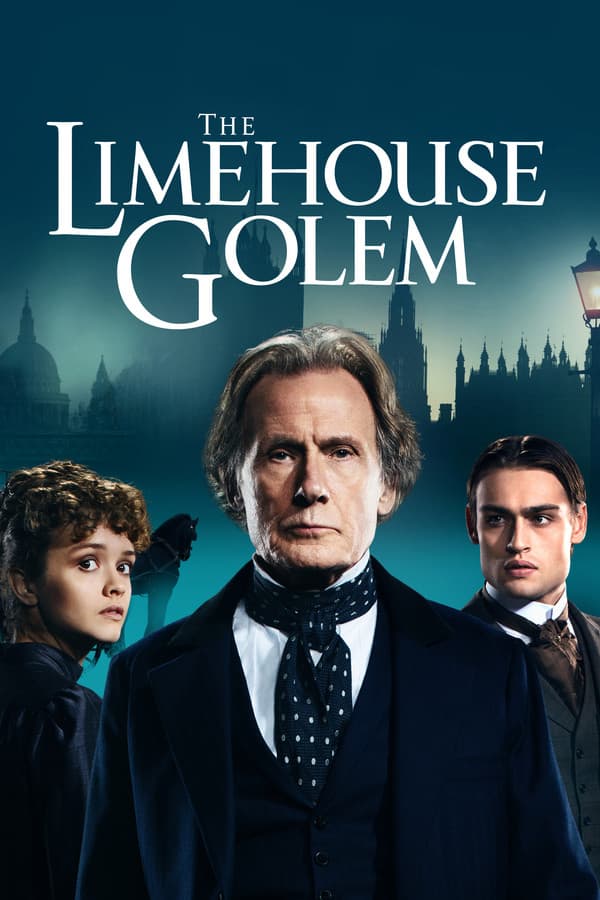
The Limehouse Golem
2016 • Horror, Mystery, Thriller
A series of murders has shaken the community to the point where people believe that only a legendary creature from dark times – the mythical Golem – must be responsible.
Runtime: 1h 49m
Buy related books from Amazon
As an Amazon Associate I earn from qualifying purchases. Read the full disclosure.
Why you should read the novel
Before you stream the film, read the source: Peter Ackroyd’s Dan Leno and the Limehouse Golem. The novel plunges you into gaslit London with intoxicating depth, recreating the music-hall world, labyrinthine alleys, and intellectual salons the movie can only glance at.
Ackroyd’s prose gives Elizabeth Cree, Dan Leno, and the era’s real historical figures a layered inner life. You’ll discover motives, diaries, playbills, and newspaper clippings that build a richer, more unsettling portrait of Victorian crime and celebrity than the screen can compress.
If you loved the movie’s atmosphere, the book delivers more: intricate clues, sly humor, and a provocative meditation on authorship and identity. For fans of literary mysteries and Victorian historical fiction, this is the definitive Limehouse Golem experience.
Adaptation differences
Book vs. movie structure: the film shapes The Limehouse Golem into a streamlined detective thriller, while Dan Leno and the Limehouse Golem is a polyphonic puzzle of documents, testimonies, and theatrical interludes. The novel’s layered narration and metafictional devices create ambiguity and texture the adaptation necessarily simplifies.
Character focus diverges markedly. The movie centers on a single, melancholic inspector to guide the investigation, whereas the book disperses perspective among Elizabeth Cree, Dan Leno, John Cree, and contemporaries, giving the music-hall world and literary milieu broader prominence. Real figures like Karl Marx and George Gissing play more nuanced roles on the page than their suspect cameos on screen.
Tone and themes shift in emphasis. Ackroyd’s novel leans into authorship, performance, and the creation of public myths—the “golem” as a metaphor for stories that take on a life of their own. The film prioritizes suspense, visual horror, and momentum, trimming the novel’s essayistic asides and historical digressions to deliver a faster genre experience.
The endings feel different. The movie offers a cleaner unmasking and a theatrical coda designed for catharsis, while the book lingers on the slippery boundaries between confession, fabrication, and self-invention. Readers will find the novel’s resolution more reflective, with clues and documents encouraging postscript analysis beyond the film’s definitive final reveal.
The Limehouse Golem inspired from
Dan Leno and the Limehouse Golem
by Peter Ackroyd